


Quenching Machine
Company Profile
Zibo Jimeng Environmental Protection Equipment Co., Ltd. is located in Huantai County, which is known as the hometown of architecture and the county of tons of grain. It is close to the former residence of Wang Yuyang, a historical and cultural celebrity. The company currently has 30 employees, covers an area of 8,000 square meters, has a standardized production workshop of 2,000 square meters and an office building of 1,000 square meters, and has a relatively complete quality control system and complete processing capabilities.
Why Choose Us
Our factory
The company currently has 30 employees, covers an area of 8,000 square meters, has a standardized production workshop of 2,000 square meters and an office building of 1,000 square meters, and has a relatively complete quality control system and complete processing capabilities.
Our product
The leading products are casting, automotive leaf springs, automotive coil springs, automotive stabilizers and other special production equipment for medium and low temperature heat treatment and industrial furnaces for other industries.
Our team
Equipped with a professional team with high and intermediate technical titles and an advanced mechanical drawing system, it is a technology-based enterprise integrating design, development, production and sales.
Our service
We try and respond to all concerns within 24 hours and our teams are always at your disposal in case of any emergencies.
Related Product

Walking Beam Reheating Furnace
The walking beam reheating furnace for automobile leaf springs is an industrial equipment specially used for heating automobile leaf springs.
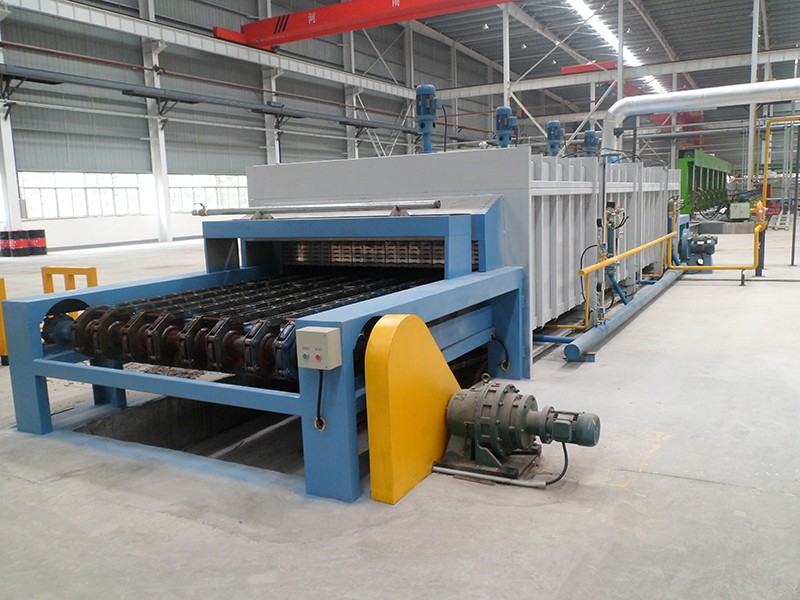
Tempering furnace is a special equipment for heat treatment process of leaf spring, suitable for mass production.

Leaf spring end heating furnace adopts advanced heating technology, which can quickly heat up in a short time and achieve efficient production rhythm.

The mandrel in-and-out mechanism, the ear coiling clamping mechanism, the flipping mechanism that revolves around the mandrel, and the positioning and lifting mechanism are all part of the ear coiling device.

It is a device specially used for cooling during the quenching process of automobile leaf springs (i.e. steel leaf springs).

Leaf springs are usually used in the suspension system of automobiles, and in their production process, drilling is a key step for installation and fixing.

It is a kind of equipment specially used for heat treatment and quenching process of automobile leaf springs. Leaf springs are usually used in the suspension system of automobiles to provide shock absorption and support functions, and the quenching process is a key step to improve the hardness and strength of leaf springs.
What Is Quenching Machine
It is a kind of equipment specially used for heat treatment and quenching process of automobile leaf springs. Leaf springs are usually used in the suspension system of automobiles to provide shock absorption and support functions, and the quenching process is a key step to improve the hardness and strength of leaf springs.
Advantages of Quenching Machine
Energy saving and power saving
Advanced components are used in the quenching equipment of integrated machine guide rail to save power, save energy and reduce cost.The efficiency is 30%~40% higher than the old scr intermediate frequency.
Quenching high precision
Customized design and production of sensors and clearance between guide surface control adopts adjustable guide wheel positioning, avoid contact between the sensor and the bed surface lighter, clearance fixed line all the time, temperature and heating time can get accurate control, smooth movement, temperature uniformity.
High quenching quality
No oxidation layer, small deformation, and the depth and hardness of the quenching layer are around 2~4 mm, which can also be determined according to the process requirements of the manufacturer.
Quenching machines come in various types, each suited for specific applications and quenching mediums. Understanding the different types of quenching machines is crucial for selecting the right equipment for your specific needs.
Immersion quenching machines
Immersion quenching machines are the most common type, where the metal component is fully immersed in a quenching medium such as water, oil, or a polymer solution. The immersion process ensures rapid and uniform cooling, which is essential for achieving the desired hardness and mechanical properties.
Spray quenching machines
Spray quenching machines use high-pressure nozzles to spray the quenching medium onto the heated metal surface. This method is particularly effective for components with complex geometries, where immersion may not provide uniform cooling.
Gas quenching machines
Gas quenching machines utilize an inert gas, such as nitrogen or helium, as the quenching medium. This method is often employed in vacuum heat treatment processes, where the absence of liquid quenching mediums is necessary to avoid contamination.
Selective quenching machines
Selective quenching machines are designed to cool only specific areas of a metal component, leaving other areas unaffected. This method is used when only certain parts of the component require hardening.
What Is Quenching Machine Used for?
Quenching is simply the rapid cooling of a metal in a medium after heat treatment. The procedure is swift to prevent a slower or more natural cooling process from changing the microstructure of the metal. These changes are broadly known as phase transformation. Hence quenching ensures you can obtain the desired material properties. Quenching is a popular term in manufacturing.
Caustic medium includes water, salt water and soda. Caustics are the fastest media in cooling and hardening metals. However, they also have a higher chance of warping the metal. Salt water is used in varying concentrations in quenching. Oils are mostly preferred for quenching because they are effective with lower risks of warping the metal. Quenching oils have diverse characteristics that allow variation in cooling rates. Gases are also commonly used as they include air and nitrogen. The gas is applied forcefully for quenching effect. Gas is often used in quenching for finished metals.
Your process determines what quenching medium is ideal, but at all times precautions must be taken because of the varying temperatures involved with the process. Quenching machines create a much safer scenario for this procedure.
Quenching is primarily used to harden steel. During quenching, the quench media interferes with the metal to introduce martensite and cool the steel through its eutectoid point. At this temperature, austenite becomes unstable and leads to the hard and brittle martensitic stage. Consequently, the metal is then tempered to reduce the brittleness of quench hardening. Before using a quenching machine, steel and iron are of a pearlitic grain structure. This structure has a characteristic softness which makes it unsuitable for most applications of steel alloys.
Therefore, quenching is used to transform the metals into a harder structure of martensite through its rapid cooling effect after heat treatment. Treated steels and irons with the martensitic structure are useful in various applications especially when it is necessary for the metal to be highly resistant to damage.
Quenching is a safe and efficient method of hardening metal (mostly steel). It prevents the steel from transitioning from austenite into ferrite and cementite. The process is specific to obtain a martensitic transformation.
Quenching machines are relatively easy to operate and control. They present a more convenient way to apply quenching media and harden metals. They are a standard addition to manufacturing or metallurgical companies.
Quenching Machine and Method for Fixture Quenching by Induction
In the case of a fixture hardening device which has a calibration mandrel as part of the calibrating device, there is the problem that the workpiece shrinks during cooling on hardening during this hardening mandrel and can only be released from it again by force and material wear. One known approach is to use a spreading mandrel as a calibration mandrel. Since the workpiece is the splayed expanding mandrel and thus shrinks on the splayed expansion mandrel, a game between the expanding mandrel and the workpiece can be created by relaxing the expanding mandrel after completion and so the workpiece are more easily solved by expanding mandrel. However, corresponding embodiments of hardening presses with an expanding mandrel as part of the calibration device have the disadvantage that they are very prone to failure.
The invention is therefore based on the object to provide a device and an associated method, with which the process steps of the previous multi-part process line, consisting essentially of rotary hearth furnace, multiple transport systems, tempering furnace, washing device and oil cooling are economically feasible.
The hardening machine for fixture hardening has a workpiece holder for the workpiece, a cooling device for quenching the heated workpiece and a calibration device with one or more calibration forms for calibrating the workpiece during the cooling process, and the inductor is advantageously designed to be relative to the one or more calibration forms of the calibration device can be brought into two positions. From a first remote position, it can be brought into a second position, in which the inductor cooperates with the workpiece introduced into the hardening machine and fixturharehandeten, which is held at least on a part of the one or more calibration forms of the calibration, so that located in this position workpiece can be heated by means of the inductor.
The existing in the curing machine inductor makes an additional tempering furnace and / or an additional fixture hardening upstream furnace for the heating of the workpiece superfluous. Therefore, both a handling system of a heated workpiece for transporting a workpiece from the oven to the curing machine, as well as a handling system for transporting a workpiece from the hardening machine to the tempering furnace is no longer required.
Advantageously, the calibration device has a calibration mandrel for calibrating the workpiece during the cooling process, and the inductor cooperates advantageously with the workpiece brought into the hardening machine and held in place by the calibration mandrel, so that the workpiece is positioned on the calibration mandrel by means of the inductor is heated.
This makes it possible to disengage a workpiece which has been shrunk onto the calibration mandrel during fixture hardening without significant wear of the calibration mandrel and without damaging the calibrated surface of the workpiece without significant expenditure of force from the calibration mandrel.
Choosing the Right Quenching Machine
Selecting the right quenching machine for your specific application involves considering several factors. These include the type of metal, the desired mechanical properties, the size and geometry of the component, and the quenching medium. Here are some key considerations:
Material compatibility
Different metals require different quenching methods and mediums. For example, steel alloys typically use water or oil quenching, while non-ferrous metals may require air or gas quenching. Understanding the material properties is essential for choosing the right quenching machine.
Component geometry
The shape and size of the metal component play a significant role in determining the appropriate quenching machine. Complex geometries may benefit from spray quenching, while simpler shapes may be better suited for immersion quenching.
Quenching medium
The choice of quenching medium affects the cooling rate and the final properties of the metal. Water provides the fastest cooling rate, but it may cause distortion or cracking in some alloys. Oil offers a slower cooling rate, reducing the risk of defects but may require additional cleaning steps.
Production volume
For high-volume production, automated quenching machines with conveyor systems may be more suitable, ensuring consistent results and reducing labor costs. For smaller batches or specialized components, manual or semi-automated machines may offer greater flexibility.
How to Implement Best Practices for Quenching Machine Maintenance
Regular inspection and cleaning
Establishing a routine for visual inspections is crucial in catching potential issues early. Regularly inspect the induction quenching machine for signs of wear, loose components, or any abnormalities. Pay close attention to the condition of coils, cooling systems, and power supply components.
Maintain a clean working environment around the induction quenching machine. Dust, debris, or coolant residues can affect the machine's performance and lead to premature wear. Regularly clean and remove any contaminants from the machine's surfaces, coils, and cooling systems to ensure optimal efficiency.
Cooling system maintenance
The cooling system plays a crucial role in preventing the machine from overheating during operation. Regularly check coolant levels and top up or replace the coolant as needed. Insufficient coolant can lead to elevated temperatures, affecting the efficiency and lifespan of the machine.
Heat exchangers are integral components of the cooling system. Over time, they can accumulate dirt and scale, hindering heat dissipation. Incorporate regular cleaning of heat exchangers into the maintenance routine to ensure the efficient transfer of heat away from the induction quenching machine.
Calibration and alignment
Maintain precision in the induction quenching process by regularly calibrating the machine. This ensures that the equipment delivers the intended levels of power, frequency, and temperature. Calibrate sensors, controls, and power sources to guarantee accurate and consistent results in heat treatment.
The alignment of the induction coil is critical for uniform heating. Periodically verify the alignment of the coil with the workpiece. Misalignment can lead to uneven heating, affecting the quality of the heat-treated components. Adjust and realign the coil as needed to maintain optimal performance.
Lubrication of moving part
Induction quenching machines often include moving parts, such as conveyors or part-handling systems. Regularly lubricate these components to reduce friction and prevent premature wear. Follow manufacturer recommendations for the type and frequency of lubrication to ensure smooth operation.
The motor and drive systems are essential for the movement of components within the induction quenching machine. Inspect these systems regularly for signs of wear, overheating, or unusual noises. Address any issues promptly to prevent further damage and maintain the reliability of the machine.
Our factory
Zibo Jimeng Environmental Protection Equipment Co., Ltd. is located in Huantai County, which is known as the hometown of architecture and the county of tons of grain. It is close to the former residence of Wang Yuyang, a historical and cultural celebrity. The company currently has 30 employees, covers an area of 8,000 square meters, has a standardized production workshop of 2,000 square meters and an office building of 1,000 square meters, and has a relatively complete quality control system and complete processing capabilities. Equipped with a professional team with high and intermediate technical titles and an advanced mechanical drawing system, it is a technology-based enterprise integrating design, development, production and sales. The leading products are casting, automotive leaf springs, automotive coil springs, automotive stabilizers and other special production equipment for medium and low temperature heat treatment and industrial furnaces for other industries.


Our Certificate


FAQ
Hot Tags: quenching machine, China quenching machine suppliers, factory, leaf spring envelopes, leaf spring foam inserts, vacuum tempering, automatic pcb drilling machine price, Quenching Machine, leaf spring stickers
Previous
Tempering FurnaceYou Might Also Like


Send Inquiry