


Leaf Spring Equipments
Company Profile
Zibo Jimeng Environmental Protection Equipment Co., Ltd. is located in Huantai County, which is known as the hometown of architecture and the county of tons of grain. It is close to the former residence of Wang Yuyang, a historical and cultural celebrity. The company currently has 30 employees, covers an area of 8,000 square meters, has a standardized production workshop of 2,000 square meters and an office building of 1,000 square meters, and has a relatively complete quality control system and complete processing capabilities.
Why Choose Us
Our factory
The company currently has 30 employees, covers an area of 8,000 square meters, has a standardized production workshop of 2,000 square meters and an office building of 1,000 square meters, and has a relatively complete quality control system and complete processing capabilities.
Our product
The leading products are casting, automotive leaf springs, automotive coil springs, automotive stabilizers and other special production equipment for medium and low temperature heat treatment and industrial furnaces for other industries.
Our team
Equipped with a professional team with high and intermediate technical titles and an advanced mechanical drawing system, it is a technology-based enterprise integrating design, development, production and sales.
Our service
We try and respond to all concerns within 24 hours and our teams are always at your disposal in case of any emergencies.


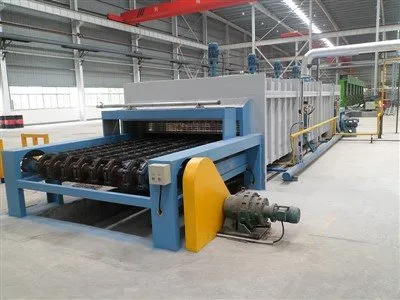


Leaf Spring Equipments Includes
Walking Beam Reheating Furnace
What Is Walking Beam Reheating Furnace
Walking beam furnaces are heating furnaces that are utmost well organized for processing large or heavy components in semi continuous mode. This furnace heats products from all sides, whereas a walking hearth furnace heat the product from top only. The product handling system of walking beam is manufactured with high temperature steel alloys in custom shapes. This furnace’s lift and shift mechanism used for heavy products. Most walking beam furnace are designed to reheat long, heavy and flat products. The furnace is appropriate for reheating products such as beam, blanks, slabs, blooms, billets, etc.
The heating system is flexible and adaptable
When the length of the furnace is fixed, the number of charges in the furnace can be changed by changing the distance between the steels, so as to meet the needs of rolling mill output and steel grade change. By adjusting the step-by-step cycle, the heating time of steel in the furnace can be changed, so as to meet the needs of different steel grades and different heating speeds.
The heating quality is better and the steel temperature is more uniform
Because there is a certain distance between the steel in the walking beam reheating furnaces, the heating area of the steel is increased, and the temperature difference of the steel section is reduced. In addition, because the movement of the steel material depends on the bottom of the furnace, and does not slide directly on the bottom of the furnace, there will be no scratches on the lower surface of the billet.
Accurately calculate
It can accurately calculate and control the heating speed and time of steel in the furnace, which is conducive to the automation of the whole heating process.
The high degree of automation
Furnace temperature control adopts double cross-limiting control with the dynamic limiting band to realize second and third level automatic control.
Difference Between Push-steel Reheating Furnace and Walking Beam Reheating Furnace
Push-type continuous reheating furnace relies on the pusher to complete the task of conveying material in the furnace.
The billet slides on the bottom of the reheating furnace or on a slide supported by a water-cooled tube. In the latter case, the billet can be heated on both sides. Bottom water pipes are usually coated with insulation materials to reduce heat loss. In order to reduce the “black mark” on the lower part of the billet caused by the water-cooled sliding track, the “hot sliding track” which insulates the billet from the water pipe has been adopted in recent years. Some small continuous reheating furnaces use water-free sliding tracks made of special ceramic materials, which are supported on the base wall built by refractory materials. This kind of furnace is called a “water-free furnace”.
Walking type continuous reheating furnace transfers billet step by step to forward continuous reheating furnace by the action of rising, advancing, descending and retreating of furnace bottom or water-cooled metal beam.
The reheating furnace has a fixed bottom and a walking beam, or a fixed beam and a walking beam. The former is called the walking bottom reheating furnace, and the latter is called the walking beam reheating furnace.
Walking beam of reheating furnace for steel rolling usually consists of a water-cooled pipe. Walking beam reheating furnace can heat billet on both sides. Since the 1970s, walking beam reheating furnace has been widely used because of the large-scale rolling mill. Compared with push-steel furnace, its advantages are: flexible material transportation, if necessary, all the burden can be discharged out of the furnace; the billet can be switched apart on the bottom or beam of the furnace, which can be heated more quickly and evenly; the failure of arch steel and sticking steel of push-steel furnace is completely eliminated, so that the length of the furnace is not limited by these factors.
Walking Beam Reheat Furnace Designed for Removing Scale
The furnace allows the products to be heated to high temperatures, about 1150 ° C for a carbon steel. Heating the furnace is commonly done by burners operating in slightly excess air which results in the presence of oxygen in the oven. A high oxidation of the products in the oven results from the combination of a high temperature and the presence of oxygen.
It shows a longitudinal beam furnace equipped with fixed spars, and movable spars. The spars consist of cooled andirons and keels. The movable spars allow the products to be transported in the furnace following a rectangular cycle comprising a first phase of rise which makes it possible to lift the products of the fixed spars. This is followed by a second phase of horizontal transport and then a third phase of removal of the products on the fixed spars. The products have thus moved one step on the fixed spars before the fourth phase of return back of the movable spars in their initial position. The total duration of a rectangular cycle is approximately 50 seconds. The fixed andirons are carried by pins integral with the hearth of the oven. The andirons mobile are carried by keels which cross the hearth of the oven and are fixed, under the oven, on a translation chassis. The translation chassis is based on a mechanism that ensures a rectangular cycle by the horizontal and vertical movement of the frame assembly, bowling and andirons mobile.
To limit the black marks caused by the shade of the andirons on the products, the side members can be shifted transversely towards the exit of the oven. At the crossing of the sole by the mobile keels, the seal between the sole and the mechanics in the oven is obtained by longitudinal water tanks, integral with the translation frame, traversed by the movable keels, and metal skirts integral with the sole and diving into the water of the tanks. Oblong openings in the hearth, necessary for the relative longitudinal movement of the movable keels, constitute a passage to evacuate the scale to the water tanks. However the evacuation thus obtained is not entirely satisfactory, especially in the areas of the oven where the scale is mainly produced, especially towards the exit of the oven.
The steel reheating furnaces operate continuously and have significant production capacity, for example 400 t / h. The weight loss of the products resulting from the oxidation is commonly of the order of 0.6%. When it comes off the products, calamine falls on the oven floor where it accumulates. At the place of the offset of the andirons, and towards the exit of the furnace where the temperature of the products is greater, it is formed more of calamine, that is why it is necessary that it is evacuated periodically. By the term "calamine" is meant not only calamine itself, but more generally any polluting residue, generally solid.

Walking Beam Reheat Furnace Designed for Removing Scale
They are then hot rolled in the rod rolling mill into wire rods in diameters between 5.5-12.5 mm. Prior to rod rolling, the billets are passing through a walking beam furnace, where they may be heated up to 1,300 degrees Celsius (2,370 degrees Fahrenheit).
The most important factor for the heating process is that we have good control of the furnace temperature to get an even temperature distribution through the billets. The walking beam process is a tried-and-tested technique for moving rectangular and square materials through a hot furnace. However what makes this furnace unique is that the heating is entirely electric. Traditionally either gas or oil is used to fuel the heating in such furnaces, both of which have lower thermal efficiency and generate large amounts of CO2.
One main difference is of course the working environment: the electric furnace generate less noise and less dust. The lack of exhaust gases also means that we avoid the chimneys that are needed with gas furnaces, and by extension we then reduce our energy consumption. Overall, we don’t need the same amount of energy to generate the same heat. And with access to fossil free electric power the electric furnace is probably the most sustainable heating solution.
Quenching Pool
What Is Quenching Pool
A closed vessel containing a relatively large volume of liquid. The emergency vent stream is sparged subsurface through the liquid volume at high velocity, resulting in vigorous agitation and circulation of the pool contents in order to maximize cooling and condensation or reaction with the pool liquid. Most or all of the vented stream can be captured; residual vapor and non-condensable gas may be released to the vent header system for further treatment or disposal.
Advantages of Quenching Pool
Lessening metal part distortion
Slower and more uniform cooling of parts is possible using higher quench media temperatures as the quenching heat treatment process is performed. This process also allows for a more uniform transformation during hardening.
Temperature control
The precision of temperature control is one of the main factors affecting the quality of the quenching process. The temperature control accuracy of the quenching tank is usually within ± 1 °c or even higher. This is usually achieved by using precise temperature controllers, sensors, and feedback control mechanisms.

A quenching bath is an industrial machine that cools down hot materials quickly. There are many types and applications of quenching baths for different materials.
Water quenching bath
It is the most common type of quenching bath. It consists of a container or tank filled with water. The heated material is usually immersed in the water for cooling. It is widely used in the metalworking and heat treatment industries, especially for quenching steel and other ferrous metals. In addition, some non-metal materials, such as glass, can also be processed by a water quenching bath.
Oil quenching bath
It has a similar structure to a water quenching bath, but it is filled with oil instead of water. Oil quenching baths are used in the same industrial applications as their water-based counterparts. In addition, oil quenching baths are often used in situations where slower cooling rates are required to achieve specific material properties.
Salt quenching bath
A salt quenching bath contains molten salt. It is a more specialized type of quenching bath. Salt quenching baths are often used when precise temperature control and rapid cooling are required, such as in the aerospace and automotive industries. This is because the molten salts can maintain a stable high temperature for a long time.
Gas quenching bath
A gas quenching bath uses gases like nitrogen, helium, or argon to cool materials. It is usually applied to heat-treat metals with complex shapes or delicate components. This is because gas quenching can provide uniform cooling without the risk of distortion or damage.
Polymer quenching bath
A polymer quenching bath uses polymer solutions or coolants to cool down materials. It is often used in the plastic manufacturing and polymer industries. Polymer quenching baths can help improve the durability, strength, and other important properties of plastic materials.
Scenarios of Using Quenching Pool
Various industries use quenching baths for different applications. Here are some of the scenarios in which the quenching bath is used.
Heat treatment
Heat treatment is a well-known application in the metallurgy industry. The quenching bath assists in the control of the temperature to enhance the strength and durability of the material. The process involves heating a metal component to a specific temperature and then rapidly cooling it by immersing it into a quenching bath. This can improve the material's hardness, toughness, and wear resistance.
Manufacturing
Manufacturing is another common application of quenching baths. The quenching bath is used to cool down freshly manufactured products to a desirable temperature. For instance, in the automotive industry, quenching baths are used to cool down engine components, chassis parts, and other metal structures during the manufacturing process. This is done to improve the structural integrity and performance of the final product.
Food and beverage
Quenching baths are used in the food and beverage industry to cool down food products and beverages quickly. For example, in the meat processing industry, quenching baths can be used to cool down freshly cooked meat to preserve its freshness and taste. In the brewing industry, quenching baths are used to cool down hot wort to start the fermentation process. The use of quenching baths in the food and beverage industry ensures the safety and quality of the end products.
Research and development
Quenching baths are also used in research and development laboratories for various scientific experiments and material testing. For example, in the field of material science, quenching baths can be used to rapidly cool down samples to study their microstructure and mechanical properties. In the field of chemistry, quenching baths can be used for quick cooling reactions and synthesis processes. The use of quenching baths in R&D laboratories enables researchers to conduct experiments efficiently and accurately.
Measuring Flow in Quenching Pool
The process in the quenching basin itself is of crucial importance. It is also important to adhere to the critical cooling rate to make sure the component cools down evenly. Otherwise tensions can arise and cause cracks in the component.
Quenching medium can be water, oil and aqueous polymer solutions depending on the steel grade. Unalloyed carbon steel is hardened in water, lower alloyed steel in oil. In order to reach all areas of the component to be hardened or quenched, it has to be moved in the hardening bath. Circulation pumps in the quenching basin ensure continuous flow. In addition heat conducting plates in the basins support the even distribution of the liquid in the oil hardening bath or in the water hardening bath.
The achieved quenching speed in the quenching basin is of decisive importance for the hardening process. Medium flow in the hardening bath is a central factor in process control and thus for the steel quality.
Using vane wheel sensors specifically adjusted to this measurement can be used in the water hardening bad horizontally and vertically no matter what kind of hardening bath. The sensors can also be moved in the quenching basin for purely stationary measurements at relevant points in the quenching basin of the hardening shop. This allows recording the spatial distribution of flow in the hardening bath reliably.
The sensors measure reliably in different temperatures and aggresive media. Made from stainless steel they’re suited for the use in hardening baths, whether it’s oil or water, and can be used with a transducer oder handheld unit.
The handheld unit comes in especially handy when flow has to be measured at different places of the hardening baths. It records measuring values that are then available for later evaluation.
Our factory
Zibo Jimeng Environmental Protection Equipment Co., Ltd. is located in Huantai County, which is known as the hometown of architecture and the county of tons of grain. It is close to the former residence of Wang Yuyang, a historical and cultural celebrity. The company currently has 30 employees, covers an area of 8,000 square meters, has a standardized production workshop of 2,000 square meters and an office building of 1,000 square meters, and has a relatively complete quality control system and complete processing capabilities. Equipped with a professional team with high and intermediate technical titles and an advanced mechanical drawing system, it is a technology-based enterprise integrating design, development, production and sales. The leading products are casting, automotive leaf springs, automotive coil springs, automotive stabilizers and other special production equipment for medium and low temperature heat treatment and industrial furnaces for other industries.


Our Certificate


FAQ