


Walking Beam Reheating Furnace
Company Profile
Zibo Jimeng Environmental Protection Equipment Co., Ltd. is located in Huantai County, which is known as the hometown of architecture and the county of tons of grain. It is close to the former residence of Wang Yuyang, a historical and cultural celebrity. The company currently has 30 employees, covers an area of 8,000 square meters, has a standardized production workshop of 2,000 square meters and an office building of 1,000 square meters, and has a relatively complete quality control system and complete processing capabilities.
Why Choose Us
Our factory
The company currently has 30 employees, covers an area of 8,000 square meters, has a standardized production workshop of 2,000 square meters and an office building of 1,000 square meters, and has a relatively complete quality control system and complete processing capabilities.
Our product
The leading products are casting, automotive leaf springs, automotive coil springs, automotive stabilizers and other special production equipment for medium and low temperature heat treatment and industrial furnaces for other industries.
Our team
Equipped with a professional team with high and intermediate technical titles and an advanced mechanical drawing system, it is a technology-based enterprise integrating design, development, production and sales.
Our service
We try and respond to all concerns within 24 hours and our teams are always at your disposal in case of any emergencies.
Related Product

Walking Beam Reheating Furnace
The walking beam reheating furnace for automobile leaf springs is an industrial equipment specially used for heating automobile leaf springs.
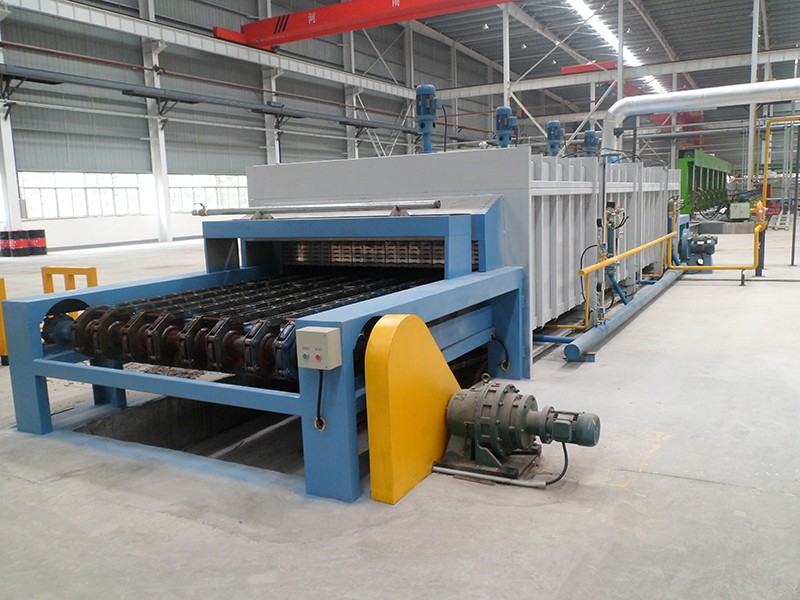
Tempering furnace is a special equipment for heat treatment process of leaf spring, suitable for mass production.

Leaf spring end heating furnace adopts advanced heating technology, which can quickly heat up in a short time and achieve efficient production rhythm.

The mandrel in-and-out mechanism, the ear coiling clamping mechanism, the flipping mechanism that revolves around the mandrel, and the positioning and lifting mechanism are all part of the ear coiling device.

It is a device specially used for cooling during the quenching process of automobile leaf springs (i.e. steel leaf springs).

Leaf springs are usually used in the suspension system of automobiles, and in their production process, drilling is a key step for installation and fixing.

It is a kind of equipment specially used for heat treatment and quenching process of automobile leaf springs. Leaf springs are usually used in the suspension system of automobiles to provide shock absorption and support functions, and the quenching process is a key step to improve the hardness and strength of leaf springs.
What Is Walking Beam Reheating Furnace
The walking beam reheating furnace for automobile leaf springs is an industrial equipment specially used for heating automobile leaf springs. Its main function is to uniformly heat the leaf springs to meet the requirements of subsequent processing, such as quenching or tempering, thereby improving the hardness, toughness and service life of the leaf springs.
Advantages of Walking Beam Reheating Furnace
Low energy consumption and flexible and convenient operation
A walking beam reheating furnace saves about 10% energy compared to a push-steel continuous heating furnace. The steel can move forward or backward in the furnace. When inspecting and changing the steel type, the stepping mechanism can be used to empty and withdraw all the billets, which reduces the labor intensity of emptying the furnace and reduces the oxidation of the steel in the furnace. The furnace loading amount can also be controlled according to the size of the rolling output, and the heating time in the furnace remains unchanged.
Strong adaptability
The walking heating furnace is suitable for heating a variety of steel materials such as ingots, billets, slabs, round billets, etc., and has no strict requirements on the length, thickness, etc. of the steel. In short, although the walking heating furnace has a relatively complex structure, a large investment, and is difficult to maintain, it is mostly used by manufacturers because of its above-mentioned characteristics.
The Truth About Walking Beam Reheating Furnace
The billets heated is not limited by the shape and size of cross-section, so push-steel reheating furnace can be heated. Large slabs, special-shaped slabs and small and thinner billets which are difficult to be heated in reheating furnace.
The heating system is flexible and adaptable. When the length of the furnace is fixed, the number of charges in the furnace can be changed by changing the distance between the steels, so as to meet the needs of rolling mill output and steel grade change. By adjusting the step-by-step cycle, the heating time of steel in the furnace can be changed, so as to meet the needs of different steel grades and different heating speeds.
The heating quality is better and the steel temperature is more uniform. Because there is a certain distance between the steel in the walking beam reheating furnaces, the heating area of the steel is increased, and the temperature difference of the steel section is reduced. In addition, because the movement of the steel material depends on the bottom of the furnace, and does not slide directly on the bottom of the furnace, there will be no scratches on the lower surface of the billet.
The length of the furnace is not limited by the pushing ratio. It will not only avoid accidents such as arch steel and sticking steel, but also increase the length of the furnace and increase the production capacity of the furnace. The hearth strength of large walking beam reheating furnaces can reach 800-1000kg/(m2 h).
It is flexible and convenient to cooperate with the rolling mill. The steel can be withdrawn from the furnace according to the need to avoid the oxidation and decarbonization caused by the long-term stopping of the steel in the furnace. It can also make the steel material stagnate in the furnace to meet the needs of rolling mill output changes. It can accurately calculate and control the heating speed and time of steel in the furnace, which is conducive to the automation of the whole heating process. The high degree of automation: Furnace temperature control adopts double cross-limiting control with the dynamic limiting band to realize second and third level automatic control. Equipped with the perfect thermal automation control system to ensure strict air-to-air ratio and reasonable furnace pressure control is to minimize heat loss and fuel consumption.
Walking Beam Reheating Furnace Designed for Removing Scale
The furnace allows the products to be heated to high temperatures, about 1150 ° C for a carbon steel. Heating the furnace is commonly done by burners operating in slightly excess air which results in the presence of oxygen in the oven. A high oxidation of the products in the oven results from the combination of a high temperature and the presence of oxygen.
To limit the black marks caused by the shade of the andirons on the products, the side members can be shifted transversely towards the exit of the oven.
At the crossing of the sole by the mobile keels, the seal between the sole and the mechanics in the oven is obtained by longitudinal water tanks, integral with the translation frame, traversed by the movable keels, and metal skirts integral with the sole and diving into the water of the tanks. Oblong openings in the hearth, necessary for the relative longitudinal movement of the movable keels, constitute a passage to evacuate the scale to the water tanks. However the evacuation thus obtained is not entirely satisfactory, especially in the areas of the oven where the scale is mainly produced, especially towards the exit of the oven.
The steel reheating furnaces operate continuously and have significant production capacity, for example 400 t / h. The weight loss of the products resulting from the oxidation is commonly of the order of 0.6%. When it comes off the products, calamine falls on the oven floor where it accumulates. At the place of the offset of the andirons, and towards the exit of the furnace where the temperature of the products is greater, it is formed more of calamine, that is why it is necessary that it is evacuated periodically. By the term "calamine" is meant not only calamine itself, but more generally any polluting residue, generally solid.
The removal of the scale can be carried out during periodic stops of the oven. This solution is not satisfactory because it leads to a significant loss of production because of the time required for cooling the oven, the manual removal of scale, then the rise in temperature of the oven. The oven can be equipped with scrubbing doors (or side) from which an operator will corny, that is to say, scrape and mechanically remove the calamine using a tool, rake type. This solution is not satisfactory either because access to the calamine located in the center of the oven is not easy. In addition, the opening of these scrubber doors causes air to enter the oven which has the effect of increasing the oxidation of the products present inside.
Technical Specifications of Equipment and Facilities of the Walking Beam Reheating Furnace
Steel Structure of The Furnace Body
The steel structure of the furnace body is a weldment made of plain carbon steel plate and a variety of steels, and it is used to install and support the refractory material of the furnace, to support the bottom beam of the furnace, to install the burners, furnace door and accessories on both sides of the furnace, equipments and pipes of combustion system, and to install maintenance platform of meter automation etc.
The steel structure of the furnace body contains the steel structure of the hearth, the steel structure of the side wall, the steel structure of the end wall, the steel structure of the furnace roof. All these parts form a box frame structure.
Steel structure of the hearth
The bottom steel structure consists of three parts: the bottom frame and steel plate, bottom longitudinal girder and steel columns. The bottom frame of the furnace is formed with I beam, channel steel and steel plate by welding, and it's used to support the masonry materials on the bottom of the furnace and install fixed column. There are also openings for the movable columns and seal case for fixing and sealing the furnace.
The bottom steel longitudinal girder runs through the overall furnace length of the hearth to support the bottom frame.
The column is made of H-section steel and steel plate, its function is to support the bottom longitudinal girder.
Steel structure of the side wall
The steel structure of the side wall is a frame structure which is welded with I beam, channel steel and steel plate. The lower part of it is fixed by bolts in the bottom steel structure of the furnace, and the top is connected with channel steel gird beam to form a rectangle frame.
The accessories of the furnace, such as burner of the furnace, side furnace door, access door, industrial TV, laser detector and peephole, are all fixed on the steel structure of the furnace wall.
Steel structure of the end wall
The steel structure of the end wall is welded with I-section steel, channel steel and steel plate. The lower part of it is fixed by bolts in the bottom steel frame. The charging and discharging door and its driving device are installed on the head end of the steel structure.
Steel structure of the furnace roof
The main part of the steel structure of the furnace roof is the cross beam which is made of hot-rolled H-section steel. The hanging beam of furnace roof anchor brick hangs on the lower flange of the H-section steel, and the two ends of the cross beam of the H-section steel stand on the ring beam of upper steel structure (the steel structure of the side wall). To maintain the integral stability of the H-section steel, a certain amount of reinforcements between the top and lower flanges are configured.
Platforms, stairs, railings
Movable steel plate platforms on both sides of furnace. Concrete platforms leading to the hearth on both sides of furnace. Steel plate walkways leading to the control valves and burners in each section.
Stairs at the connection of diversed platforms and walkways. Railings on the margin of platform and walkway. Fully consider the multiple factors, such as appearance, safety operation.
Energy Saving Measures of Walking Beam Reheating Furnace
High efficient steel tube air preheater can preheat the combustion air to about 650ºC by recovering the heat of flue gas, thus reduce fuel consumption. The working surface has castable integrated structure, the furnace top, hearth and side wall are compound structure. Refractory has high thermal resistance value and good performance refractory to reduce heat loss.
Big spacing supporting column and water piping longitudinal beam are adopted. The supporting beams and columns are well arranged to reduce surface area of water cooling piece. The supporting beam and column have refractory fiber blanket and high strength castable dual layer insulation. The cooling is water cooling. The walking mechanism should consider the walking beam is moving at low speed while supporting and lowering the billet. The scale loss will be lower and the impact to the insulation layer of water cooling beam will be less.
The furnace door will be in optimal configuration. The structure will be designed with flexible opening and closing. The seal will be tight to reduce heat loss.
Our factory
Zibo Jimeng Environmental Protection Equipment Co., Ltd. is located in Huantai County, which is known as the hometown of architecture and the county of tons of grain. It is close to the former residence of Wang Yuyang, a historical and cultural celebrity. The company currently has 30 employees, covers an area of 8,000 square meters, has a standardized production workshop of 2,000 square meters and an office building of 1,000 square meters, and has a relatively complete quality control system and complete processing capabilities. Equipped with a professional team with high and intermediate technical titles and an advanced mechanical drawing system, it is a technology-based enterprise integrating design, development, production and sales. The leading products are casting, automotive leaf springs, automotive coil springs, automotive stabilizers and other special production equipment for medium and low temperature heat treatment and industrial furnaces for other industries.


Our Certificate


FAQ
Hot Tags: walking beam reheating furnace, China walking beam reheating furnace suppliers, factory, leaf spring reducers, automatic magnetic drilling machine, leaf spring compressors, automatic drilling machine ppt, glass tempering furnace price, leaf spring packaging materials
Previous
Leaf Spring Forming EquipmentYou Might Also Like


Send Inquiry