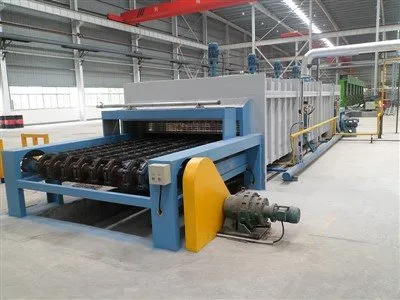
Hey there! I'm a supplier of Trolley Heating Furnaces, and today I'm gonna chat about the temperature range of a typical trolley heating furnace.
First off, let's understand what a trolley heating furnace is. It's a type of industrial furnace that uses a trolley to load and unload materials. This design makes it super convenient for handling large or heavy loads. The furnace can be used for various heat - treating processes like annealing, normalizing, quenching, and tempering.
Now, the temperature range of a typical trolley heating furnace can vary quite a bit depending on its specific application and design. Generally speaking, these furnaces can operate anywhere from around 200°C (392°F) to 1300°C (2372°F).
Low - end Temperature Range (200°C - 600°C)
At the lower end of the temperature spectrum, around 200°C to 600°C, trolley heating furnaces are often used for processes like stress relieving. When metal parts are fabricated, they can develop internal stresses during operations such as machining, welding, or casting. These stresses can cause the parts to deform over time or even crack. By heating the parts to a relatively low temperature and holding them there for a specific period, we can relieve these internal stresses and improve the dimensional stability of the parts.
Another application in this temperature range is pre - heating. Before some metal parts go through more intense heat - treating processes or welding, pre - heating them can help reduce thermal shock. For example, when welding thick steel plates, pre - heating the plates to around 200 - 300°C can prevent the formation of cracks due to rapid cooling after welding.
Medium - end Temperature Range (600°C - 900°C)
The medium - end temperature range, from 600°C to 900°C, is where a lot of annealing processes take place. Annealing is a heat - treating process that softens the metal, improves its ductility, and refines its grain structure. For instance, in the case of copper and brass, annealing at around 600 - 700°C can make the metal more malleable, which is great for further forming operations like bending or stamping.
Normalizing is also a common process in this temperature range. Normalizing involves heating the metal to a specific temperature and then allowing it to cool in air. This process helps to homogenize the microstructure of the metal and improve its mechanical properties. For carbon steels, normalizing at around 800 - 900°C can result in a more uniform grain size and better strength - to - ductility ratio.
High - end Temperature Range (900°C - 1300°C)
When we move up to the high - end temperature range, from 900°C to 1300°C, things get more intense. Quenching is a process that often takes place at these high temperatures. Quenching involves heating the metal to a very high temperature and then rapidly cooling it, usually by immersing it in a quenching medium like oil, water, or polymer solution. This rapid cooling can transform the microstructure of the metal, making it extremely hard. For example, in the production of high - strength steel parts like gears or shafts, quenching at temperatures above 900°C can significantly increase their hardness and wear resistance.

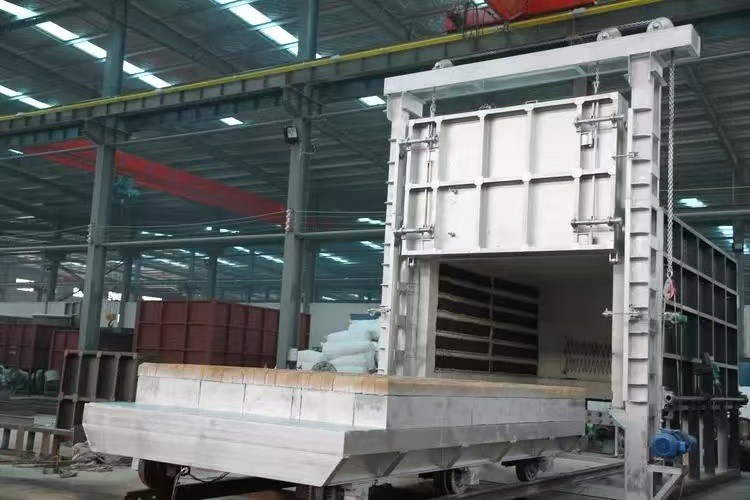
Tempering is often done after quenching. Tempering involves reheating the quenched metal to a lower temperature (usually in the range of 200 - 600°C) to relieve the internal stresses generated during quenching and to improve the toughness of the metal. However, the initial quenching step requires high temperatures within the 900 - 1300°C range.
The temperature range of a trolley heating furnace is not set in stone. There are many factors that can affect it. The type of material being heat - treated is a major factor. Different metals and alloys have different phase transformation temperatures, which determine the optimal temperature range for heat - treating them. For example, aluminum alloys typically have lower heat - treating temperatures compared to high - alloy steels.
The size and shape of the workpiece also matter. Larger or thicker workpieces may require a slower heating rate and a more precise temperature control to ensure uniform heating throughout the part. If the heating rate is too fast, the outer layers of the workpiece may heat up much faster than the inner layers, leading to thermal gradients and potential cracking.
The design and construction of the trolley heating furnace itself play a crucial role. The quality of the heating elements, the insulation materials, and the control system can all impact the achievable temperature range and the accuracy of temperature control.
If you're in the market for a trolley heating furnace, you might also be interested in some other types of furnaces. Check out our Spitfire Furnace, which is known for its high - performance heating capabilities. Our Melting Furnace is great for melting various metals, and the Storing Heat Heating Furnace offers excellent energy - saving features.
We've got a wide range of trolley heating furnaces to suit different temperature requirements and industrial applications. Whether you need a furnace for low - temperature stress relieving or high - temperature quenching, we can provide you with the right solution. If you're interested in learning more about our products or have any questions regarding the temperature range and application of our trolley heating furnaces, don't hesitate to get in touch with us. We're here to help you make the best choice for your business.
References
- ASM Handbook Volume 4: Heat Treating. ASM International.
- Fundamentals of Heat Treating of Steels. The AISE Steel Foundation.