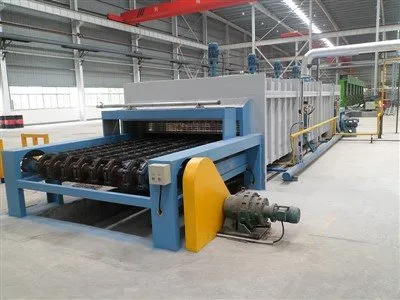
Heat transfer is a fundamental process in various industrial applications, and in the context of a forging furnace, understanding its mechanism is crucial for optimizing performance, improving efficiency, and ensuring high - quality forging products. As a reputable forging furnace supplier, we are well - versed in the intricacies of heat transfer within these furnaces.
1. Basics of Heat Transfer
Heat transfer occurs through three main mechanisms: conduction, convection, and radiation. Each of these plays a significant role in a forging furnace, and their combined effects determine how effectively the furnace can heat the metal to the desired forging temperature.
Conduction
Conduction is the transfer of heat through a material without the movement of the material itself. In a forging furnace, conduction occurs within the metal workpiece and the furnace components. When the furnace is heated, the heat is first transferred to the inner lining of the furnace. The inner lining, usually made of refractory materials, conducts heat from the heat source (such as burners or electric heating elements) to the metal workpiece placed inside the furnace.
The rate of conduction is governed by Fourier's law of heat conduction, which states that the heat flux (q) is proportional to the temperature gradient (dT/dx) and the thermal conductivity (k) of the material. Mathematically, it is expressed as (q=-k\frac{dT}{dx}). In the case of a forging furnace, materials with high thermal conductivity are preferred for the parts that need to transfer heat efficiently, while materials with low thermal conductivity are used for insulation to minimize heat loss.
Convection
Convection involves the transfer of heat by the movement of a fluid (either a gas or a liquid). In a forging furnace, convection occurs mainly in the gaseous medium inside the furnace. When the furnace is heated, the hot gases near the heat source become less dense and rise, while the cooler gases sink. This creates a natural convection current.
Forced convection can also be introduced in some forging furnaces. For example, fans can be used to circulate the hot gases more uniformly throughout the furnace. This helps to ensure that the metal workpiece is heated evenly. The heat transfer coefficient (h) is an important parameter in convection heat transfer. It depends on factors such as the fluid velocity, the properties of the fluid, and the geometry of the furnace. The heat transfer rate by convection (Q) can be calculated using the formula (Q = hA\Delta T), where A is the surface area of the object being heated and (\Delta T) is the temperature difference between the fluid and the object.
Radiation
Radiation is the transfer of heat through electromagnetic waves. Unlike conduction and convection, radiation does not require a medium to transfer heat. In a forging furnace, radiation is a significant mode of heat transfer, especially at high temperatures. The heat source in the furnace, such as burners or electric heating elements, emits thermal radiation. This radiation travels through the space inside the furnace and is absorbed by the metal workpiece.
The rate of heat transfer by radiation between two surfaces is given by the Stefan - Boltzmann law. For a blackbody, the heat flux (q) is given by (q=\sigma T^{4}), where (\sigma) is the Stefan - Boltzmann constant ((5.67\times10^{-8}W/m^{2}K^{4})) and T is the absolute temperature of the surface. In real - world applications, the emissivity ((\epsilon)) of the surfaces needs to be considered, and the formula becomes (q=\epsilon\sigma(T_{1}^{4}-T_{2}^{4})), where (T_{1}) and (T_{2}) are the absolute temperatures of the two surfaces.
2. Heat Transfer in Different Types of Forging Furnaces
Melting Furnace
A melting furnace is designed to heat the metal to its melting point. In this type of furnace, all three heat transfer mechanisms are at work. At the initial stage, when the metal is in a solid state, conduction and radiation play a dominant role. The heat from the burners or electric heaters is radiated to the metal surface, and conduction helps to transfer the heat from the surface to the interior of the metal.
As the metal starts to heat up and the temperature rises, convection becomes more significant. The hot gases inside the furnace circulate and transfer heat to the metal. Once the metal starts to melt, convection within the molten metal also contributes to the heat transfer, ensuring a more uniform temperature distribution.
Storing Heat Heating Furnace
A storing heat heating furnace is designed to store heat during off - peak hours and release it when needed. In this furnace, heat is stored in a thermal storage material, such as a refractory brick. Conduction is important for transferring heat from the heat source to the storage material. The high - temperature heat source heats the refractory bricks, and the heat is stored in them through conduction.
When the stored heat is released to heat the metal workpiece, convection and radiation come into play. The hot refractory bricks radiate heat to the metal, and the hot gases in the furnace transfer heat by convection. The design of these furnaces is optimized to ensure efficient heat storage and release, taking into account the thermal properties of the storage material and the heat transfer mechanisms.
Trolley Heating Furnace
A trolley heating furnace is used for heating large - scale metal workpieces. The trolley allows the workpiece to be easily loaded and unloaded from the furnace. In this furnace, radiation is a major mode of heat transfer, especially when the workpiece is first placed inside the hot furnace. The high - temperature inner walls of the furnace radiate heat to the workpiece.
Convection also helps to distribute the heat evenly. The hot gases inside the furnace circulate around the workpiece, and forced convection can be used to enhance this process. Conduction is important for transferring heat within the workpiece itself, ensuring that the entire workpiece reaches the desired forging temperature.
3. Factors Affecting Heat Transfer in Forging Furnaces
Furnace Design
The design of the forging furnace has a significant impact on heat transfer. The shape and size of the furnace, the location of the heat source, and the arrangement of the insulation all affect how heat is transferred. For example, a well - designed furnace will have a proper distribution of burners or heating elements to ensure uniform heat distribution. The insulation should be designed to minimize heat loss, which can improve the overall efficiency of the furnace.
Material Properties
The properties of the metal workpiece and the furnace components also play a role in heat transfer. The thermal conductivity of the metal determines how quickly it can absorb heat. Metals with high thermal conductivity, such as copper and aluminum, heat up faster than metals with low thermal conductivity, such as stainless steel. The emissivity of the metal surface affects the rate of radiation heat transfer.

Operating Conditions
The operating conditions, such as the temperature of the heat source, the gas flow rate (in the case of convection), and the heating time, also affect heat transfer. Higher heat source temperatures will increase the rate of heat transfer, but they also need to be carefully controlled to avoid over - heating the metal. The gas flow rate in forced - convection furnaces can be adjusted to optimize the heat transfer and ensure uniform heating.
4. Importance of Understanding Heat Transfer for Forging Furnace Suppliers
As a forging furnace supplier, understanding the heat transfer mechanism is essential for several reasons. Firstly, it allows us to design and manufacture more efficient furnaces. By optimizing the heat transfer processes, we can reduce energy consumption and lower the operating costs for our customers.
Secondly, a good understanding of heat transfer helps us to ensure the quality of the forging products. Uniform heating of the metal workpiece is crucial for producing high - quality forged parts. If the heat transfer is not well - controlled, it can lead to uneven heating, which can result in defects such as cracking or inconsistent mechanical properties in the forged parts.
Finally, it enables us to provide better technical support to our customers. We can offer advice on furnace operation, maintenance, and troubleshooting based on our knowledge of heat transfer. For example, if a customer is experiencing problems with uneven heating, we can analyze the heat transfer mechanisms in the furnace and recommend appropriate solutions.
5. Conclusion and Call to Action
In conclusion, the heat transfer mechanism in a forging furnace is a complex process involving conduction, convection, and radiation. Each mechanism plays a vital role, and their combined effects determine the efficiency and performance of the furnace. Different types of forging furnaces, such as Melting Furnace, Storing Heat Heating Furnace, and Trolley Heating Furnace, have unique heat transfer characteristics.
If you are in the market for a forging furnace or need to upgrade your existing furnace, our team of experts is ready to assist you. We have a wide range of high - quality forging furnaces that are designed with the latest heat transfer technologies to ensure optimal performance and energy efficiency. Contact us today to discuss your specific requirements and start a fruitful procurement negotiation.
References
- Incropera, F. P., & DeWitt, D. P. (2002). Fundamentals of Heat and Mass Transfer. John Wiley & Sons.
- Holman, J. P. (2009). Heat Transfer. McGraw - Hill.
- Kreith, F., Manglik, R. M., & Bohn, M. S. (2010). Principles of Heat Transfer. Cengage Learning.