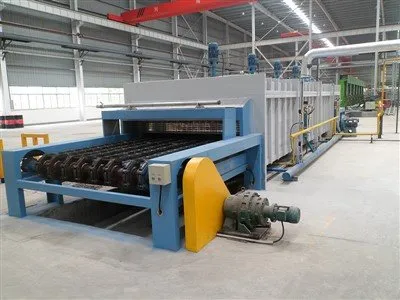
Quenching is a crucial process in materials science and engineering, used to enhance the mechanical properties of metals by rapidly cooling them. A quenching pool is an essential component of this process, and understanding the heat transfer mechanisms within it is vital for optimizing the quenching process and ensuring the quality of the treated materials. As a quenching pool supplier, I have witnessed firsthand the importance of these mechanisms in various industrial applications. In this blog, I will delve into the heat transfer mechanisms in a quenching pool and explain how they impact the overall quenching process.
Conduction
Conduction is the transfer of heat through a material or between materials in direct contact. In a quenching pool, conduction plays a significant role in the initial stages of the quenching process. When a hot metal part is immersed in the quenching medium, heat is transferred from the metal to the surrounding liquid through direct contact. The rate of conduction depends on several factors, including the thermal conductivity of the metal and the quenching medium, the temperature difference between the metal and the liquid, and the surface area of contact.
Metals generally have high thermal conductivities, which means they can transfer heat quickly. For example, copper has a thermal conductivity of about 400 W/(m·K), while steel has a thermal conductivity ranging from 15 to 50 W/(m·K), depending on its composition. The quenching medium also has a significant impact on the conduction process. Water, for instance, has a relatively high thermal conductivity of about 0.6 W/(m·K), which makes it an effective quenching medium for many applications. However, other fluids, such as oil or polymers, may be used depending on the specific requirements of the quenching process.
The temperature difference between the hot metal and the quenching medium is another critical factor in conduction. The greater the temperature difference, the higher the rate of heat transfer. This is because heat always flows from a region of higher temperature to a region of lower temperature, and a larger temperature gradient provides a stronger driving force for heat transfer. Additionally, increasing the surface area of contact between the metal and the quenching medium can also enhance conduction. This can be achieved by using a quenching pool with a large surface area or by agitating the quenching medium to ensure better contact with the metal part.
Convection
Convection is the transfer of heat by the movement of a fluid. In a quenching pool, convection occurs due to the density differences in the quenching medium caused by temperature variations. When a hot metal part is immersed in the quenching medium, the liquid near the metal surface heats up and becomes less dense. This less-dense liquid rises, while the cooler, denser liquid from the surrounding area moves in to replace it. This creates a convective flow pattern that helps to transfer heat away from the metal surface.
There are two types of convection: natural convection and forced convection. Natural convection occurs spontaneously due to the density differences in the fluid, as described above. Forced convection, on the other hand, is induced by an external force, such as a pump or a stirrer. In a quenching pool, forced convection can be used to enhance the heat transfer rate by increasing the fluid velocity and improving the mixing of the quenching medium.


The convective heat transfer coefficient is a measure of the efficiency of convection in transferring heat. It depends on several factors, including the fluid properties (such as density, viscosity, and thermal conductivity), the flow velocity, and the geometry of the system. In general, higher flow velocities and lower viscosities result in higher convective heat transfer coefficients. For example, using a high-speed pump to circulate the quenching medium can significantly increase the convective heat transfer rate and improve the quenching efficiency.
Radiation
Radiation is the transfer of heat through electromagnetic waves. Unlike conduction and convection, radiation does not require a medium to transfer heat and can occur in a vacuum. In a quenching pool, radiation plays a relatively minor role compared to conduction and convection, especially at lower temperatures. However, at very high temperatures, radiation can become a significant heat transfer mechanism.
The rate of radiation heat transfer is proportional to the fourth power of the absolute temperature of the radiating body, according to the Stefan - Boltzmann law. This means that as the temperature of the hot metal part increases, the rate of radiation heat transfer increases rapidly. For example, a metal part at a temperature of 1000 K will radiate heat much more intensely than the same part at 500 K.
The emissivity of the metal surface also affects the radiation heat transfer rate. Emissivity is a measure of how efficiently a surface emits radiation compared to a perfect blackbody. A blackbody has an emissivity of 1, while most metals have emissivities ranging from 0.1 to 0.3. A higher emissivity means that the surface can radiate heat more effectively.
Impact on Quenching Process and Equipment Design
Understanding the heat transfer mechanisms in a quenching pool is essential for optimizing the quenching process and designing efficient quenching equipment. For example, by controlling the temperature difference between the metal and the quenching medium, the rate of heat transfer can be adjusted to achieve the desired cooling rate. This is crucial because the cooling rate during quenching determines the microstructure and mechanical properties of the treated metal.
In terms of equipment design, the choice of quenching medium and the design of the quenching pool can be optimized to enhance heat transfer. For instance, a quenching pool with a well - designed circulation system can improve convection and ensure uniform cooling of the metal parts. Additionally, the use of advanced materials with high thermal conductivities can enhance conduction and improve the overall quenching efficiency.
As a quenching pool supplier, we offer a range of products that are designed to take advantage of these heat transfer mechanisms. Our quenching pools are equipped with efficient circulation systems to promote forced convection and ensure uniform cooling. We also provide a variety of quenching media options to meet the specific requirements of different applications.
If you are in the market for a reliable quenching pool, or if you are interested in learning more about the heat transfer mechanisms and how they can be optimized for your specific quenching process, we encourage you to reach out to us. We have a team of experts who can provide you with detailed information and guidance on selecting the right quenching equipment for your needs.
In addition to quenching pools, we also offer related equipment such as Automatic Drilling Machine and Leaf Spring Forming Equipment. These products are designed to work in conjunction with our quenching pools to provide a comprehensive solution for your metal processing needs. You can also check out our Automatic Drilling Machine for more details.
Contact us today to start a discussion about your quenching requirements and explore how our products can help you achieve better results in your metal processing operations.
References
- Incropera, F. P., & DeWitt, D. P. (2002). Fundamentals of Heat and Mass Transfer. John Wiley & Sons.
- Holman, J. P. (2002). Heat Transfer. McGraw - Hill.
- Carslaw, H. S., & Jaeger, J. C. (1959). Conduction of Heat in Solids. Oxford University Press.