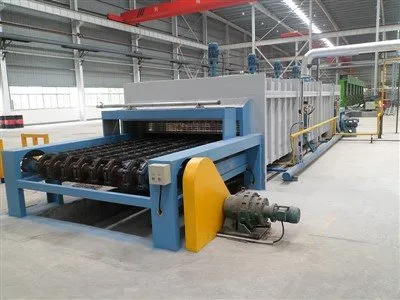
How to Program the Control System of a Holding Furnace?
As a reputable holding furnace supplier, I've witnessed firsthand the critical role that a well - programmed control system plays in the efficient and reliable operation of holding furnaces. In this blog, I'll share some insights on how to program the control system of a holding furnace, drawing on my years of experience in the industry.

Understanding the Basics of a Holding Furnace Control System
Before delving into programming, it's essential to understand the basic components of a holding furnace control system. A typical control system consists of sensors, actuators, a controller, and a user interface. Sensors, such as thermocouples, are used to measure process variables like temperature, pressure, and level. Actuators, such as heaters and valves, are responsible for adjusting these variables. The controller, often a programmable logic controller (PLC) or a microcontroller, processes the sensor data and sends commands to the actuators. The user interface allows operators to monitor and control the furnace's operation.
Defining the Control Objectives
The first step in programming the control system is to clearly define the control objectives. For a holding furnace, the primary objective is usually to maintain a specific temperature within the furnace chamber. Other objectives may include controlling the heating rate, ensuring uniform temperature distribution, and preventing over - heating or under - heating.
To define the temperature setpoint, you need to consider the requirements of the process for which the furnace is used. For example, if the furnace is used for annealing metals, the temperature setpoint will be determined by the specific metal and the annealing process. Once the setpoints are determined, you can set them in the control system.
Selecting the Control Algorithm
There are several control algorithms available for programming the control system of a holding furnace. The most commonly used algorithm is the Proportional - Integral - Derivative (PID) control algorithm. The PID controller calculates an error value as the difference between the setpoint and the actual process variable. It then uses proportional, integral, and derivative terms to adjust the output of the controller.
The proportional term provides an immediate response to the error, the integral term eliminates the steady - state error, and the derivative term anticipates future errors based on the rate of change of the error. The PID algorithm is widely used because it is relatively simple to implement and can provide good control performance in many applications.
To implement the PID algorithm in the control system, you need to tune the PID parameters (proportional gain, integral time, and derivative time). Tuning can be done manually by trial and error or using automatic tuning methods.
Programming the Controller
Once you have selected the control algorithm, you can start programming the controller. If you are using a PLC, the programming is typically done using ladder logic, function block diagrams, or structured text. Ladder logic is a graphical programming language that resembles electrical circuit diagrams, making it easy for electrical engineers and technicians to understand.
When programming the controller, you need to write code to read the sensor values, calculate the control output based on the control algorithm, and send the control signals to the actuators. For example, if you are using a thermocouple to measure the furnace temperature, you need to write code to read the thermoelectric voltage from the thermocouple and convert it to temperature. Then, you calculate the control output using the PID algorithm and send the appropriate signal to the heater to adjust the temperature.
Incorporating Safety Features
Safety is a top priority when programming the control system of a holding furnace. You need to incorporate several safety features to prevent accidents and equipment damage. One important safety feature is over - temperature protection. You can program the controller to shut off the heater if the temperature exceeds a certain limit.
Another safety feature is flame supervision. If the furnace uses a burner, the control system should monitor the flame and shut off the fuel supply if the flame goes out. Additionally, you can program the controller to provide alarms and warnings if there are any abnormal conditions in the furnace, such as low pressure or high vibration.
Testing and Commissioning the Control System
After programming the control system, it's crucial to test and commission it before putting the holding furnace into operation. During the testing phase, you should simulate different operating conditions and verify that the control system responds correctly. You can use test benches or simulators to emulate the behavior of the sensors and actuators.
Commissioning involves installing the control system in the actual holding furnace, wiring all the components, and calibrating the sensors and actuators. You should also train the operators on how to use the control system and the safety procedures.
Integration with Other Equipment
In many industrial settings, the holding furnace needs to be integrated with other equipment, such as Automatic Quenching Furnace and Continuous Tempering Furnace. The control system should be programmed to communicate with these other systems.
For example, if the holding furnace is part of a heat - treating line, the control system needs to coordinate with the quenching and tempering furnaces to ensure a smooth and efficient process. Communication protocols such as Modbus, Profibus, or Ethernet/IP can be used to establish the connection between the different control systems.
Maintenance and Troubleshooting of the Control System
Once the control system is in operation, regular maintenance is required to ensure its reliability. You should perform routine checks on the sensors, actuators, and the controller to detect any potential issues early.
In case of a malfunction, troubleshooting skills are essential. You need to be able to identify the source of the problem, whether it's a sensor failure, an actuator malfunction, or a programming error. Diagnostic tools and techniques, such as error codes and data logging, can be used to assist in the troubleshooting process.
Conclusion
Programming the control system of a holding furnace is a complex but rewarding task. By understanding the basic components, defining the control objectives, selecting the appropriate control algorithm, and incorporating safety features, you can develop a control system that ensures the efficient and reliable operation of the holding furnace.
If your business is in need of a high - quality holding furnace or assistance with programming its control system, we would be more than happy to help. Our team of experienced engineers and technicians can provide you with customized solutions tailored to your specific requirements. We also offer comprehensive after - sales support, including maintenance, troubleshooting, and upgrades. Contact us today to discuss your needs and start a productive partnership.
References
- Dorf, R. C., & Bishop, R. H. (2017). Modern Control Systems. Pearson.
- Kuo, B. C. (2002). Automatic Control Systems. Wiley.
- Karnopp, D. C., Margolis, D. L., & Rosenberg, R. C. (2012). System Dynamics: Modeling, Simulation, and Control of Mechatronic Systems. Wiley.