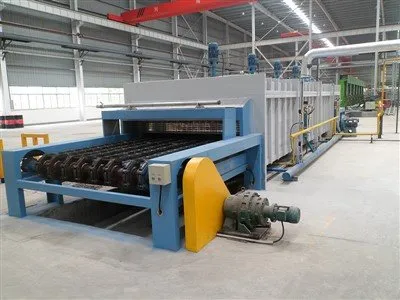
Quenching is a critical heat treatment process widely used in the manufacturing industry to enhance the mechanical properties of metal workpieces. As a leading quenching machine supplier, we understand the importance of quenching stress distribution in workpieces processed by our machines. In this blog, we will delve into the intricacies of quenching stress distribution, its influencing factors, and its implications for workpiece quality.
Understanding Quenching Stress
Quenching stress refers to the internal stress generated within a workpiece during the quenching process. When a heated workpiece is rapidly cooled, the surface layer cools down much faster than the core, resulting in a significant temperature difference between the surface and the core. This temperature gradient causes uneven shrinkage of the material, leading to the formation of internal stress. Quenching stress can be classified into two types: thermal stress and phase - transformation stress.
Thermal stress is caused by the non - uniform temperature distribution in the workpiece during quenching. As the surface cools rapidly, it contracts and tries to pull the still - hot core. Meanwhile, the core resists this contraction due to its higher temperature and lower stiffness at that moment. This interaction between the surface and the core generates thermal stress.
Phase - transformation stress, on the other hand, is associated with the phase changes that occur during quenching. When the steel workpiece is cooled below a certain critical temperature, austenite transforms into martensite. This phase transformation is accompanied by a volume expansion. Since the surface and the core transform at different times, the volume changes are not synchronized, resulting in phase - transformation stress.
Factors Affecting Quenching Stress Distribution
1. Workpiece Geometry
The shape and size of the workpiece have a profound impact on quenching stress distribution. Complex geometries, such as workpieces with sharp corners, holes, or sudden changes in cross - section, can cause stress concentrations. For example, at sharp corners, the cooling rate is much faster compared to other parts of the workpiece, leading to higher thermal stress. The Volume Ear Machine, which can be found at Volume Ear Machine, is designed to handle specific workpiece geometries. It can help in reducing stress concentrations by ensuring a more uniform cooling process for certain types of workpieces.
2. Quenching Medium
The choice of quenching medium plays a crucial role in determining the cooling rate and, consequently, the quenching stress distribution. Different quenching media, such as water, oil, and polymer solutions, have different cooling capabilities. Water has a high cooling rate, which can lead to large thermal stress due to the rapid temperature drop at the surface. Oil, on the other hand, has a lower cooling rate, resulting in relatively lower thermal stress. Polymer solutions offer a controllable cooling rate that can be adjusted according to the requirements of the workpiece. Our quenching machines are compatible with a variety of quenching media, allowing for precise control of the cooling process.
3. Heating and Cooling Rates
The heating rate before quenching and the cooling rate during quenching affect the quenching stress distribution. A rapid heating rate can cause thermal shock and increase the initial internal stress in the workpiece. During quenching, a very high cooling rate will exacerbate the temperature gradient between the surface and the core, leading to higher thermal stress. Our quenching machines are equipped with advanced heating and cooling control systems that can precisely regulate these rates to minimize quenching stress.
4. Material Properties
The chemical composition and microstructure of the workpiece material also influence quenching stress distribution. Different materials have different thermal expansion coefficients and phase - transformation characteristics. For example, steels with high carbon content are more prone to phase - transformation stress due to the large volume change associated with the austenite - to - martensite transformation. Our technical team has in - depth knowledge of various materials and can provide customized quenching solutions based on the material properties of the workpiece.


Implications of Quenching Stress Distribution on Workpiece Quality
1. Distortion
Excessive quenching stress can cause workpiece distortion. The uneven internal stress can lead to bending, warping, or dimensional changes in the workpiece. This is a major concern in industries where precise dimensions are required, such as aerospace and automotive manufacturing. By carefully controlling the quenching stress distribution, our quenching machines can minimize workpiece distortion and ensure high - precision parts.
2. Cracking
High quenching stress, especially when it exceeds the material's strength, can result in cracking. Cracks can significantly reduce the mechanical properties and service life of the workpiece. For example, in the manufacturing of high - strength components, such as shafts and gears, cracking due to quenching stress can lead to premature failure. Our quenching machines are designed to optimize the stress distribution and reduce the risk of cracking.
3. Residual Stress
Quenching stress can leave residual stress in the workpiece after the quenching process. Residual stress can affect the fatigue life and corrosion resistance of the workpiece. Tensile residual stress can accelerate crack propagation under cyclic loading, while compressive residual stress can improve fatigue resistance. Our quenching machines can be used in combination with post - quenching processes, such as stress relieving, to manage the residual stress in the workpiece.
Measuring and Controlling Quenching Stress Distribution
1. Measuring Quenching Stress
There are several methods available for measuring quenching stress, including X - ray diffraction, ultrasonic testing, and hole - drilling methods. X - ray diffraction can measure the residual stress on the surface of the workpiece by analyzing the lattice spacing of the material. Ultrasonic testing can detect internal stress based on the change in the ultrasonic wave velocity. Hole - drilling methods involve drilling a small hole in the workpiece and measuring the strain relaxation around the hole to calculate the residual stress.
2. Controlling Quenching Stress
To control quenching stress distribution, we can adopt several strategies. One approach is to use pre - heating before quenching to reduce the temperature gradient during cooling. Another method is to use interrupted quenching, where the workpiece is cooled to a certain temperature and then held for a period of time to allow for stress relaxation before further cooling. Our quenching machines support these advanced quenching techniques to achieve optimal stress distribution.
Applications of Our Quenching Machines in Different Industries
Our quenching machines have a wide range of applications in various industries. In the automotive industry, they are used to quench engine components, such as crankshafts and camshafts, to improve their strength and wear resistance. In the aerospace industry, our machines are employed to process high - strength materials for aircraft parts, ensuring their reliability under extreme conditions.
The Walking Beam Reheating Furnace and Volume Ear Furnace can be used in conjunction with our quenching machines to provide a complete heat treatment solution. These furnaces are designed to heat the workpieces uniformly before quenching, which is essential for achieving a favorable quenching stress distribution.
Conclusion
Understanding the quenching stress distribution in workpieces processed by a quenching machine is crucial for ensuring high - quality products. As a quenching machine supplier, we are committed to providing advanced quenching solutions that can optimize the stress distribution, minimize distortion and cracking, and improve the overall performance of the workpiece. Our state - of - the - art quenching machines, combined with our technical expertise, can meet the diverse needs of different industries.
If you are interested in our quenching machines or have any questions about quenching stress distribution, please feel free to contact us for a detailed discussion. We look forward to working with you to achieve the best results in your heat treatment processes.
References
- Totten, G. E., & MacKenzie, D. E. (2004). Handbook of Quenching: Theory and Practice. ASM International.
- Liscic, B. (2007). Quenching and the Properties of Steel. Butterworth - Heinemann.
- Wilson, W. C. (2012). Heat Treater's Guide: Practices and Procedures for Non - Ferrous Metals. ASM International.