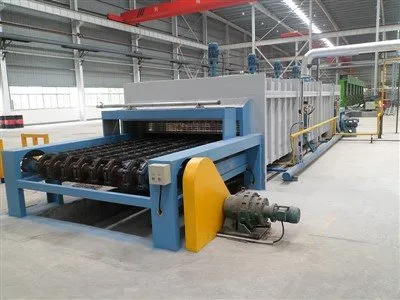
Hey there! As a supplier of Continuous Tempering Furnaces, I often get asked about the differences between a continuous tempering furnace and a quenching furnace. So, I thought I'd write this blog to break it down for you in a way that's easy to understand.
Let's start with the basics. Both continuous tempering furnaces and quenching furnaces are used in the heat treatment process, but they serve different purposes and have distinct features.
What is a Quenching Furnace?
A quenching furnace is mainly used to rapidly cool a metal workpiece after it has been heated to a specific temperature. The goal of quenching is to harden the metal by transforming its microstructure. When a metal is heated in a quenching furnace and then quickly cooled, usually by immersion in a quenching medium like oil, water, or polymer solution, it forms a very hard and brittle structure.
This process is crucial in industries where high hardness and wear resistance are required, such as the automotive and aerospace industries. For example, in the production of engine components or aircraft parts, quenching helps to ensure that the parts can withstand high-stress conditions.
However, quenching also has its drawbacks. The rapid cooling can cause internal stresses in the metal, which may lead to cracking or distortion. That's where tempering comes in.
What is a Continuous Tempering Furnace?
A Continuous Tempering Furnace is designed to relieve the internal stresses created during the quenching process and to improve the toughness and ductility of the metal. After quenching, the metal is heated to a lower temperature in the continuous tempering furnace and held there for a specific period of time. This process allows the metal to become more stable and less brittle.
One of the key advantages of a continuous tempering furnace is its ability to provide a consistent and uniform heat treatment. It can handle a continuous flow of workpieces, which makes it ideal for mass production. The conveyor system in a continuous tempering furnace moves the workpieces through different temperature zones, ensuring that each piece receives the same treatment.
Key Differences between the Two Furnaces
1. Temperature and Process
The temperature used in a quenching furnace is much higher than that in a continuous tempering furnace. Quenching typically involves heating the metal to its austenitizing temperature, which can range from 700°C to 1000°C depending on the type of metal. In contrast, tempering is done at a lower temperature, usually between 150°C and 650°C.
The process in a quenching furnace is a rapid cooling, while in a continuous tempering furnace, it's a slow and controlled heating. Quenching is all about creating a hard structure, while tempering is about refining that structure and improving the overall properties of the metal.
2. Equipment Design
Quenching furnaces are often designed with a large heating chamber and a quenching tank. The heating chamber needs to be able to heat the metal quickly and evenly, and the quenching tank is used to rapidly cool the metal.
On the other hand, continuous tempering furnaces are designed with a conveyor system that moves the workpieces through the furnace. The furnace is divided into different zones with different temperatures, allowing for a gradual and controlled heating process. Some continuous tempering furnaces also have a Conveyor Chain system to ensure smooth movement of the workpieces.


3. Application and Output
Quenching furnaces are mainly used for applications where high hardness is required, such as cutting tools, gears, and springs. The output of a quenching process is a hard and brittle metal.
Continuous tempering furnaces are used to improve the toughness and ductility of the quenched metal. The final product after tempering is a metal that has a good balance of hardness, toughness, and ductility, making it suitable for a wide range of applications, including automotive parts, machinery components, and structural steel.
Why Choose Our Continuous Tempering Furnaces?
As a supplier of continuous tempering furnaces, we take pride in offering high-quality products that meet the needs of our customers. Our furnaces are designed with the latest technology to ensure efficient and reliable operation.
- Energy Efficiency: Our continuous tempering furnaces are equipped with advanced insulation materials and energy-saving burners, which can significantly reduce energy consumption.
- Precise Temperature Control: We use state-of-the-art temperature control systems to ensure that the temperature in the furnace is accurate and stable. This helps to produce high-quality products with consistent properties.
- Customization: We understand that different customers have different requirements. That's why we offer customized solutions to meet the specific needs of each customer. Whether you need a small furnace for a laboratory or a large-scale production line, we can design and manufacture the right furnace for you.
Contact Us for Your Heat Treatment Needs
If you're in the market for a continuous tempering furnace or have any questions about the differences between a continuous tempering furnace and a quenching furnace, don't hesitate to contact us. We have a team of experts who can provide you with professional advice and guidance.
We're committed to providing the best products and services to our customers. Let's work together to find the perfect heat treatment solution for your business.
References
- ASM Handbook, Volume 4: Heat Treating. ASM International.
- Metals Handbook Desk Edition, Third Edition. ASM International.
- Heat Treatment Principles and Techniques. Elsevier.