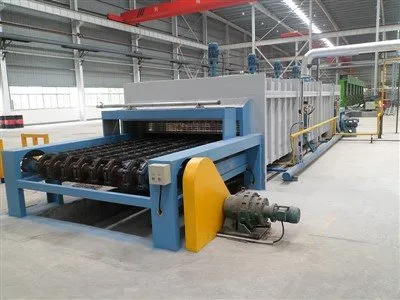
As a supplier of Volume Ear Furnaces, one of the most frequently asked questions we receive from our clients is, "How long does it take for a Volume Ear Furnace to reach the desired temperature?" This query is crucial as it directly impacts production efficiency, energy consumption, and overall operational costs. In this blog post, we'll delve into the factors that influence the heating time of a Volume Ear Furnace and provide insights to help you understand this process better.
Understanding the Volume Ear Furnace
Before we discuss the heating time, let's briefly introduce the Volume Ear Furnace. The Volume Ear Furnace is a specialized piece of equipment used in various industrial processes, particularly in the manufacturing of components where precise temperature control is essential. It offers uniform heating, high energy efficiency, and excellent temperature stability, making it a popular choice for many industries. If you're interested in learning more about related equipment, you can check out our Volume Ear Machine.
Factors Affecting the Heating Time
Several factors play a significant role in determining how long it takes for a Volume Ear Furnace to reach the desired temperature. Let's explore these factors in detail:
1. Furnace Size and Capacity
The size and capacity of the furnace are among the most critical factors affecting heating time. Larger furnaces with higher capacities generally take longer to heat up compared to smaller ones. This is because there is more mass to heat, including the furnace walls, heating elements, and the material inside the furnace. For example, a small laboratory-scale Volume Ear Furnace may reach the desired temperature in a matter of minutes, while an industrial-sized furnace could take several hours.
2. Initial Temperature
The starting temperature of the furnace and the material being heated also impacts the heating time. If the furnace is already at a relatively high temperature, it will take less time to reach the desired temperature compared to a cold start. Similarly, if the material being heated is pre - heated, the overall heating time will be reduced.
3. Desired Temperature
The target temperature is another crucial factor. Higher desired temperatures require more energy and time to achieve. For instance, heating a furnace from room temperature to 500°C will take less time than heating it to 1500°C. The rate of heat transfer decreases as the temperature difference between the heating elements and the furnace interior decreases, which means that the last few degrees can take a disproportionately long time to reach.
4. Heating Element Power
The power of the heating elements in the furnace directly affects the heating rate. Furnaces equipped with high - power heating elements can transfer heat more quickly, reducing the time required to reach the desired temperature. However, using high - power heating elements also increases energy consumption, so a balance must be struck between heating time and energy efficiency.
5. Insulation
Proper insulation is essential for reducing heat loss and improving the heating efficiency of the furnace. Well - insulated furnaces retain heat better, which means they can reach the desired temperature more quickly and maintain it more easily. Poor insulation can lead to significant heat loss, increasing the heating time and energy consumption.
6. Material Properties
The properties of the material being heated, such as its specific heat capacity, thermal conductivity, and mass, also influence the heating time. Materials with high specific heat capacities require more energy to heat up, while materials with low thermal conductivities transfer heat more slowly. For example, heating a dense metal block will take longer than heating a thin sheet of the same metal.
Calculating Heating Time
While it's challenging to provide an exact formula for calculating the heating time of a Volume Ear Furnace due to the complexity of the factors involved, we can use some basic principles of thermodynamics to estimate it. The heat energy required to raise the temperature of a substance is given by the formula:
[Q = mc\Delta T]
where (Q) is the heat energy (in joules), (m) is the mass of the substance (in kilograms), (c) is the specific heat capacity (in joules per kilogram per degree Celsius), and (\Delta T) is the change in temperature (in degrees Celsius).
The power of the heating elements ((P)) is given by the formula (P=\frac{Q}{t}), where (t) is the time (in seconds). Rearranging this formula to solve for (t), we get (t=\frac{Q}{P}).
However, this calculation only provides a rough estimate and does not account for heat losses, the efficiency of the heating elements, or other real - world factors.
Case Studies
To illustrate the impact of these factors on heating time, let's look at a couple of case studies:
Case Study 1: Small - Scale Laboratory Furnace
A small laboratory - scale Volume Ear Furnace with a capacity of 10 liters is used to heat a sample of metal. The initial temperature of the furnace is 20°C, and the desired temperature is 500°C. The furnace is well - insulated, and the heating element has a power of 2 kW. The specific heat capacity of the metal is 400 J/kg°C, and the mass of the sample is 1 kg.
Using the formula (Q = mc\Delta T), we can calculate the heat energy required:
(\Delta T=500 - 20 = 480°C), (m = 1kg), (c = 400J/kg°C)
(Q=1\times400\times480 = 192000J)
Since (P = 2000W), using (t=\frac{Q}{P}), we get (t=\frac{192000}{2000}=96s) or 1.6 minutes. In reality, due to heat losses and other factors, the actual heating time may be slightly longer, but it gives us a rough estimate.
Case Study 2: Industrial - Scale Furnace
An industrial - scale Volume Ear Furnace with a capacity of 100 cubic meters is used to heat a large batch of steel. The initial temperature of the furnace is 20°C, and the desired temperature is 1200°C. The furnace has a power of 500 kW. The mass of the steel is 50 tons ((50000kg)), and the specific heat capacity of steel is 460 J/kg°C.
(\Delta T = 1200 - 20=1180°C), (m = 50000kg), (c = 460J/kg°C)
(Q=50000\times460\times1180 = 2.714\times10^{10}J)
Using (t=\frac{Q}{P}), with (P = 500000W), we get (t=\frac{2.714\times10^{10}}{500000}=54280s) or approximately 15 hours. Again, this is a simplified calculation, and the actual heating time may be longer due to heat losses and other factors.


Strategies to Reduce Heating Time
If you're looking to reduce the heating time of your Volume Ear Furnace, here are some strategies you can consider:
1. Pre - heat the Material
As mentioned earlier, pre - heating the material before placing it in the furnace can significantly reduce the overall heating time. This can be done using a separate pre - heating unit or by taking advantage of waste heat from other processes.
2. Optimize Furnace Insulation
Investing in high - quality insulation can reduce heat loss and improve the heating efficiency of the furnace. Regularly inspect and maintain the insulation to ensure its effectiveness.
3. Use High - Power Heating Elements
Upgrading to high - power heating elements can increase the rate of heat transfer and reduce the heating time. However, this should be balanced with energy costs.
4. Schedule Operations Wisely
If possible, avoid cold starts by scheduling operations in a way that keeps the furnace at a relatively high temperature between batches. This can save a significant amount of time and energy.
Conclusion
The time it takes for a Volume Ear Furnace to reach the desired temperature depends on several factors, including furnace size, initial temperature, desired temperature, heating element power, insulation, and material properties. By understanding these factors and implementing strategies to optimize the heating process, you can improve the efficiency of your operations and reduce energy consumption.
If you're in the market for a Volume Ear Furnace or related equipment such as Walking Beam Reheating Furnace or Automatic Drilling Machine, we're here to help. Our team of experts can assist you in selecting the right furnace for your specific needs and provide you with all the information you need to ensure optimal performance. Don't hesitate to contact us for more information and to discuss your procurement requirements.
References
- Incropera, F. P., & DeWitt, D. P. (2002). Fundamentals of Heat and Mass Transfer. John Wiley & Sons.
- Cengel, Y. A., & Boles, M. A. (2015). Thermodynamics: An Engineering Approach. McGraw - Hill Education.