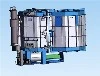
Quenching is one of the most important stages in automotive stabilizer bar heat treatment. It determines the cooling conditions required to obtain the desired mechanical properties, but it can also introduce thermal deformation.
For stabilizer bars with complex three-dimensional geometries, the way the workpiece is supported and positioned during quenching can therefore become an important production factor.
Recent research on tubular automotive stabilizer bars investigated conductive heating combined with press quenching and a multi-point clamping fixture. The study used finite element analysis to optimize clamp positions and reported improved dimensional stability compared with conventional quenching.
This shows that quenching equipment should not be considered only as a cooling system. The fixture that holds the stabilizer bar can also influence the final shape.
The Stabilizer Bar Is Not a Simple Straight Bar
A stabilizer bar normally contains several curved sections, arms, and mounting areas.
During heating and cooling, different sections can experience different thermal expansion and contraction.
The situation becomes more complicated when the bar has an asymmetric three-dimensional shape.
If different sections cool or transform at different rates, internal stresses can develop and cause dimensional changes.
Numerical research on 60Si2MnA automotive stabilizer bars has also analyzed longitudinal deformation and residual stress during quenching, showing that quenching deformation can be significant enough to require specific control methods.
This is why simply putting the hot stabilizer bar into a quenching tank may not always provide sufficient dimensional control.
What Does a Quenching Fixture Actually Do?
A quenching fixture has several functions.
It can:
Position the stabilizer bar
Maintain the required geometry during cooling
Control the location of the workpiece in the quenching medium
Reduce uncontrolled movement during quenching
Provide repeatable loading and unloading
In some production systems, the fixture can also work together with the forming or correction mechanism.
For example, a published stabilizer-bar quenching mechanism uses a clamping structure to hold and correct the workpiece before it enters the quenching medium.
The purpose is not simply to "hold the bar."
The fixture needs to provide the right amount of constraint without creating unnecessary local stress.
Clamp Position Is More Important Than Simply Adding More Clamps
Adding more fixing points does not automatically mean better dimensional stability.
The position of each clamp matters.
In the ASM QDE 2025 study, different clamping arrangements were evaluated using finite element analysis. The researchers compared four-, six-, seven-, and eight-point arrangements. The selected seven-point configuration provided better control of deformation in the studied critical areas.
This is an important engineering consideration.
The fixture should support the areas where deformation is most likely to occur while allowing the workpiece to respond to thermal expansion and phase transformation in a controlled manner.
Therefore, fixture design should be based on the actual stabilizer bar geometry rather than using the same fixture structure for every product.
The Fixture Should Match the Product Geometry
Different stabilizer bar models may have different:
Bar diameters
Arm lengths
Bending angles
End geometries
Mounting positions
Overall dimensions
A fixture designed for one specification may not provide the same support for another.
For multi-specification production, manufacturers should consider adjustable or interchangeable fixture components.
This can make product changeover easier while maintaining repeatable positioning.
Quenching Position Also Affects Cooling Conditions
The fixture determines how the stabilizer bar is positioned relative to the quenching medium.
This can influence the cooling condition around different sections of the workpiece.
For example, if one section is too close to another component or fixture element, the local cooling condition may differ from the exposed areas.
A stabilizer-bar quenching system therefore needs to consider both:
Mechanical positioning + Cooling conditions
rather than treating them as two completely independent issues.
Some published stabilizer-bar quenching equipment designs also incorporate automatic monitoring of quenching-liquid temperature, level, and other operating conditions.
Fixture Design Can Reduce the Workload on Correction
Correction is often necessary after heat treatment because some dimensional deviation can occur during quenching and tempering.
However, the amount of correction required can be influenced by upstream process stability.
A well-designed quenching fixture can help control the initial deformation during cooling.
This does not mean that the fixture can eliminate all deformation.
Instead, the objective is to make the deformation more predictable and controllable.
This gives the downstream correction operation a more stable starting condition.
Fixture Design Should Be Considered Together With the Quenching System
For equipment manufacturers, designing the fixture separately from the quenching system can create problems.
The following factors need to be considered together:
Stabilizer bar geometry
Loading method
Fixture positioning
Heating temperature
Transfer time
Quenching medium
Cooling circulation
Quenching time
Workpiece support
Unloading method
A production line should provide a repeatable relationship between these parameters.
For high-volume production, automatic loading and unloading can further improve consistency by reducing differences caused by manual positioning.
What Should Manufacturers Check When Selecting a Quenching System?
When evaluating stabilizer bar quenching equipment, manufacturers should look beyond the nominal tank size or cooling capacity.
Important questions include:
1. How is the stabilizer bar positioned before quenching?
The loading position should be repeatable.
2. How is the bar held during cooling?
The fixture should provide sufficient support without unnecessarily restricting thermal movement.
3. Can the fixture be adjusted for different specifications?
This is particularly important for plants producing multiple stabilizer bar models.
4. Is the quenching condition monitored?
Quenching-medium temperature, circulation, concentration where applicable, and liquid level can affect process consistency.
5. How is the workpiece transferred after quenching?
The unloading system should avoid introducing additional deformation before the correction or tempering stage.
A Stable Quenching System Starts With Controlled Positioning
For automotive stabilizer bar manufacturers, quenching quality is not determined only by the cooling medium.
The position and support of the workpiece during cooling can also influence the final dimensional condition.
A properly designed fixture can help reduce uncontrolled deformation, improve repeatability, and reduce variation entering the correction stage.
This is particularly important for stabilizer bars with complex three-dimensional geometry and tight dimensional requirements.
Conclusion
Quenching fixture design is a relatively small part of a stabilizer bar production line, but it can have a significant effect on dimensional stability.
The key is not simply to clamp the stabilizer bar firmly.
The fixture needs to be designed around the product geometry, deformation characteristics, cooling conditions, and production cycle.
For manufacturers planning a new automotive stabilizer bar production line, the quenching fixture should therefore be evaluated together with the heating, quenching, tempering, and correction equipment.
JIMENG can customize stabilizer bar heating, forming, quenching, tempering, correction, and material handling equipment according to product dimensions, production capacity, and process requirements.