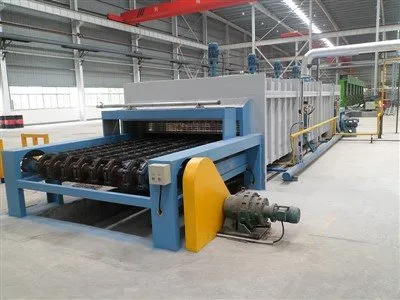
Hey there! As a supplier of Continuous Tempering Furnaces, I've seen firsthand how the tempering atmosphere can have a huge impact on the color of workpieces. So, I thought I'd share some insights on this topic with you all.
First off, let's talk about what tempering is. Tempering is a heat treatment process that's used to reduce the brittleness of a workpiece and improve its toughness and ductility. It's usually done after quenching, which is a rapid cooling process that hardens the workpiece. During tempering, the workpiece is heated to a specific temperature and held there for a certain amount of time before being cooled.


Now, the tempering atmosphere refers to the environment inside the tempering furnace. It can have a significant effect on the color of the workpiece. There are several different types of tempering atmospheres, including air, nitrogen, and vacuum.
Air Atmosphere
When you use an air atmosphere in a continuous tempering furnace, the workpiece is exposed to oxygen. This can cause oxidation, which leads to the formation of a layer of oxide on the surface of the workpiece. The color of this oxide layer depends on the temperature and the duration of the tempering process.
At lower temperatures, the oxide layer may be a light yellow or straw color. As the temperature increases, the color can change to a darker brown, purple, or even blue. These colors are often referred to as "temper colors" and are used by metallurgists to estimate the hardness and tempering temperature of the workpiece.
However, oxidation in an air atmosphere can also have some drawbacks. The oxide layer can be rough and uneven, which may affect the surface finish of the workpiece. In some cases, it can also lead to corrosion over time.
Nitrogen Atmosphere
Using a nitrogen atmosphere in a continuous tempering furnace is a popular choice because nitrogen is an inert gas. It doesn't react with the workpiece, so it helps to prevent oxidation. This results in a clean, bright surface on the workpiece, which is often desirable for aesthetic reasons.
In a nitrogen atmosphere, the workpiece retains its original metallic color. This is great for applications where the appearance of the workpiece is important, such as in the automotive or jewelry industries. Additionally, the absence of oxidation means that the surface finish is smoother and more uniform.
But there are also some considerations when using a nitrogen atmosphere. Nitrogen gas can be expensive, and maintaining a pure nitrogen atmosphere in the furnace requires proper equipment and control systems. There's also a risk of contamination if the nitrogen supply isn't pure or if there are leaks in the furnace.
Vacuum Atmosphere
A vacuum atmosphere takes the prevention of oxidation to the next level. In a vacuum, there's virtually no oxygen present, so oxidation is completely eliminated. This results in a pristine, mirror-like finish on the workpiece.
Vacuum tempering is often used for high - precision components, such as aerospace parts or medical instruments. The lack of oxidation ensures that the dimensions of the workpiece remain accurate, and the surface finish is of the highest quality.
However, vacuum tempering is a more complex and expensive process. It requires specialized equipment to create and maintain a vacuum, and the cycle times can be longer compared to other tempering atmospheres.
How to Choose the Right Atmosphere
The choice of tempering atmosphere depends on several factors. If the appearance of the workpiece is a top priority and you want to avoid oxidation, a nitrogen or vacuum atmosphere may be the best choice. For applications where temper colors are acceptable or even desired, an air atmosphere can be used.
It's also important to consider the cost and the complexity of the process. A nitrogen atmosphere may be a good compromise between cost and performance, while a vacuum atmosphere is better suited for high - end applications where quality is non - negotiable.
Our Continuous Tempering Furnaces
As a supplier of Continuous Tempering Furnaces, we offer a range of options to meet different customer needs. Our furnaces are designed to provide precise control over the tempering atmosphere, whether it's air, nitrogen, or vacuum.
We also provide other related equipment, such as Helical Spring Stepping Quenching Furnaces and Conveyor Chains. These components work together to ensure a smooth and efficient tempering process.
If you're in the market for a continuous tempering furnace or have any questions about the tempering atmosphere and its effect on workpiece color, don't hesitate to reach out. We're here to help you make the right choice for your specific application. Whether you're a small workshop or a large manufacturing plant, we have the expertise and the products to meet your requirements.
Conclusion
In conclusion, the tempering atmosphere in a continuous tempering furnace plays a crucial role in determining the color of the workpiece. Each type of atmosphere - air, nitrogen, and vacuum - has its own advantages and disadvantages. By understanding these factors, you can choose the right atmosphere for your tempering process and achieve the desired results in terms of both appearance and performance.
So, if you're looking to improve the quality of your tempered workpieces and want to learn more about our products, contact us today. Let's start a conversation and find the best solution for your business.
References
- "Metallurgy for the Non - Metallurgist" by John D. Verhoeven
- "Heat Treatment Principles and Techniques" by David A. Woodford