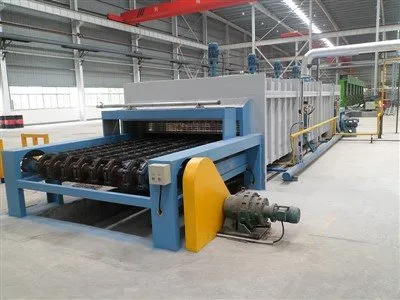
Hey there! As a supplier of Continuous Tempering Furnaces, I've seen firsthand how tempering time can significantly impact the properties of materials. In this blog, I'll break down what's going on and why it matters for your manufacturing process.
Let's start with the basics. Tempering is a heat treatment process that follows quenching. After a material is quenched, it's usually very hard and brittle. Tempering helps to reduce this brittleness and improve the material's toughness and ductility. A Continuous Tempering Furnace Continuous Tempering Furnace is designed to perform this process continuously, which is great for high - volume production.
How Tempering Works
When a material is heated during tempering, the internal stresses that built up during quenching start to relax. At the same time, the microstructure of the material begins to change. The martensite, which is the hard and brittle phase formed during quenching, starts to transform into a more stable structure. This transformation is what leads to the improvement in the material's properties.
The Role of Tempering Time
Now, let's talk about tempering time. It's a crucial factor because it determines how much the material's microstructure will change. If the tempering time is too short, the material may not fully transform, and it will still retain some of its brittleness. On the other hand, if the tempering time is too long, the material may become too soft, losing some of its strength.
Short Tempering Time
A short tempering time means that the material doesn't have enough time to fully transform its microstructure. The internal stresses may not be completely relieved, and the martensite may not be fully converted into a more stable phase. As a result, the material will still be relatively brittle. This can be a problem in applications where the material needs to withstand impact or flexing. For example, in the manufacturing of Conveyor Chain, a brittle chain link can break easily under load, leading to production downtime and increased maintenance costs.
Long Tempering Time
When the tempering time is too long, the material continues to transform beyond what is necessary. The grains in the microstructure may grow larger, and the material will become softer. While softness can be an advantage in some applications, in most cases, it's not desirable. For instance, in the production of parts for an Automatic Quenching Furnace, if the parts are too soft, they may wear out quickly, reducing the efficiency and lifespan of the furnace.
Finding the Optimal Tempering Time
So, how do you find the optimal tempering time? Well, it depends on several factors, including the type of material, the quenching process, and the desired properties of the final product.
Material Type
Different materials have different transformation rates during tempering. For example, carbon steels and alloy steels will respond differently to the same tempering time. Carbon steels generally have a faster transformation rate, so they may require a shorter tempering time compared to alloy steels. Alloy steels, which contain additional elements like chromium, nickel, and molybdenum, have a more complex microstructure and may need a longer tempering time to achieve the desired properties.
Quenching Process
The quenching process also plays a role in determining the optimal tempering time. If the quenching was very rapid, the material will have a higher level of internal stress and a more unstable microstructure. In this case, a longer tempering time may be required to relieve the stress and transform the microstructure. On the other hand, if the quenching was less severe, a shorter tempering time may be sufficient.
Desired Properties
The properties you want the final product to have will also influence the tempering time. If you need a material with high strength and moderate toughness, you'll need to find a balance between the two. This may require a specific tempering time that allows for partial transformation of the microstructure. If you need a very tough material, you may need to increase the tempering time to ensure full transformation.
Real - World Examples
Let's look at some real - world examples to illustrate the importance of tempering time.
Automotive Industry
In the automotive industry, parts like crankshafts and axles are made from high - strength steels. These parts need to be tough enough to withstand the high loads and vibrations they experience during operation. If the tempering time is too short, the parts may be brittle and prone to cracking. If it's too long, they may be too soft and wear out quickly. By carefully controlling the tempering time in a Continuous Tempering Furnace, manufacturers can ensure that these parts have the right combination of strength and toughness.
Tool Manufacturing
Tool manufacturers also rely on proper tempering time to produce high - quality tools. For example, drill bits need to be hard enough to cut through various materials but also tough enough to resist chipping. A short tempering time may result in a drill bit that is too brittle and breaks easily. A long tempering time may make the drill bit too soft, causing it to dull quickly. By optimizing the tempering time, tool manufacturers can produce drill bits that last longer and perform better.


Conclusion
In conclusion, tempering time has a significant effect on the properties of materials in a Continuous Tempering Furnace. It's a delicate balance that needs to be carefully controlled to achieve the desired properties of the final product. Whether you're in the automotive industry, tool manufacturing, or any other industry that uses heat - treated materials, understanding the role of tempering time is crucial for producing high - quality products.
If you're looking for a reliable Continuous Tempering Furnace to help you control the tempering process and optimize the properties of your materials, we're here to help. Our furnaces are designed to provide precise temperature control and consistent performance, ensuring that you can achieve the best results every time. Contact us to start a conversation about your specific needs and how we can assist you in your manufacturing process.
References
- ASM Handbook Volume 4: Heat Treating. ASM International.
- Heat Treating Principles and Processes. Robert L. Moffatt.