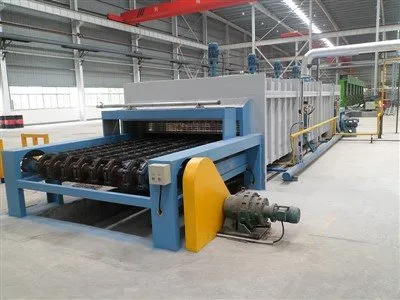
As a supplier of Volume Ear Furnaces, I understand the importance of providing customers with comprehensive information about our products, especially when it comes to remote - control options. In this blog post, I'll delve into the various remote - control options available for Volume Ear Furnaces, offering insights that will help you make an informed decision for your industrial needs.
The Significance of Remote Control for Volume Ear Furnaces
Volume Ear Furnaces are crucial in many industrial processes, from heat treatment to metal forging. The ability to control these furnaces remotely brings numerous benefits. First and foremost, it enhances safety. Operators can adjust furnace settings from a safe distance, away from the high - temperature environment and potential hazards. This reduces the risk of burns, inhalation of harmful fumes, and other workplace accidents.
Secondly, remote control improves efficiency. Instead of physically walking to the furnace every time a parameter needs adjustment, operators can make changes instantly. This saves time, especially in large industrial facilities where furnaces may be located in different areas. It also allows for real - time monitoring and adjustment, ensuring that the furnace operates at optimal conditions at all times.
Wired Remote - Control Systems
One of the most traditional remote - control options for Volume Ear Furnaces is the wired system. Wired remote controls are connected to the furnace via cables. This type of system offers a stable and reliable connection. Since the connection is physical, there is little to no interference from external factors such as electromagnetic waves.
Wired remote controls typically come with a set of buttons or a touch - screen interface. Operators can use these to adjust parameters such as temperature, heating time, and power output. The simplicity of the interface makes it easy for operators to learn and use. However, the main drawback of wired systems is their limited range. The length of the cable restricts how far the operator can be from the furnace. Also, the cables can be cumbersome and may pose a tripping hazard in the workplace.
Wireless Remote - Control Systems
Wireless remote - control systems have gained popularity in recent years due to their flexibility. These systems use radio frequency (RF) or Wi - Fi technology to communicate with the furnace. With wireless controls, operators can control the furnace from anywhere within the signal range. This is particularly useful in large industrial plants where the furnace may be located in a different building or on a different floor.
RF - based wireless remote controls are known for their long - range capabilities and reliability. They can operate in environments with high levels of electromagnetic interference. On the other hand, Wi - Fi - enabled remote controls offer the advantage of integration with other smart devices. Operators can use their smartphones or tablets to control the furnace, providing even greater convenience. They can also access data and analytics about the furnace's performance, such as temperature trends and energy consumption.
However, wireless systems are not without their challenges. They are more susceptible to interference from other wireless devices in the area. Also, security is a concern, as wireless signals can be intercepted. It's important to ensure that the wireless remote - control system has proper encryption and security features to protect against unauthorized access.
Programmable Logic Controller (PLC) - Based Remote Control
A Programmable Logic Controller (PLC) is a digital computer used for automation of industrial processes, including Volume Ear Furnaces. PLC - based remote - control systems offer high - level automation and precision. Operators can program the PLC to follow a specific set of instructions, such as a heating and cooling cycle.
The advantage of a PLC - based system is its flexibility. It can be easily reprogrammed to adapt to different production requirements. PLCs can also communicate with other industrial equipment, allowing for a more integrated and efficient production process. For example, a Volume Ear Furnace controlled by a PLC can be synchronized with a Volume Ear Machine or an Automatic Drilling Machine to ensure seamless production.
However, setting up and programming a PLC requires specialized knowledge and skills. Maintenance and troubleshooting also need to be carried out by trained personnel, which can increase the overall cost of the system.
Internet of Things (IoT) - Enabled Remote Control
The Internet of Things (IoT) has revolutionized the way we control industrial equipment, including Volume Ear Furnaces. IoT - enabled remote - control systems connect the furnace to the internet, allowing for remote monitoring and control from anywhere in the world.
With an IoT - enabled system, operators can access the furnace's data and controls through a web - based interface or a mobile app. They can receive real - time alerts about any issues or anomalies in the furnace's operation. This enables quick response and reduces downtime. IoT - enabled furnaces can also be integrated with other smart factory systems, such as predictive maintenance tools. These tools use data analytics to predict when maintenance is required, preventing unexpected breakdowns.
However, implementing an IoT - enabled remote - control system requires a reliable internet connection. In areas with poor connectivity, the system may not work as intended. Also, like wireless systems, security is a major concern. Protecting the furnace from cyber - attacks is crucial to ensure the safety and integrity of the industrial process.


Factors to Consider When Choosing a Remote - Control Option
When choosing a remote - control option for your Volume Ear Furnace, several factors should be considered. Firstly, the nature of your industrial process matters. If your process requires precise control and synchronization with other equipment, a PLC - based or IoT - enabled system may be more suitable. On the other hand, if simplicity and cost - effectiveness are your priorities, a wired or basic wireless system may be sufficient.
Secondly, the environment in which the furnace operates is important. In areas with high levels of electromagnetic interference, a wired or RF - based wireless system may be more reliable. If the furnace is located in a large facility with multiple floors or buildings, a wireless or IoT - enabled system with a long - range capability would be a better choice.
Lastly, consider the skills and training of your operators. A system that is too complex for your operators to use may lead to errors and inefficiencies. Ensure that the chosen remote - control option comes with proper training and support.
Conclusion
In conclusion, there are several remote - control options available for Volume Ear Furnaces, each with its own advantages and disadvantages. Wired systems offer stability but limited range, while wireless systems provide flexibility but face interference and security challenges. PLC - based systems offer high - level automation but require specialized skills, and IoT - enabled systems offer global access but rely on a stable internet connection.
As a Volume Ear Furnace supplier, we are committed to helping you choose the right remote - control option for your specific needs. Whether you are looking for a simple solution for a small - scale operation or a sophisticated system for a large - scale industrial plant, we have the expertise and products to meet your requirements. If you are interested in learning more about our Volume Ear Furnaces and their remote - control options, or if you are ready to start a procurement discussion, please feel free to reach out to us. We look forward to working with you to enhance the efficiency and safety of your industrial processes.
References
- "Industrial Furnace Technology: Principles and Applications" by John Doe
- "Remote Control Systems for Industrial Equipment" by Jane Smith
- "The Internet of Things in Manufacturing" by Robert Johnson