

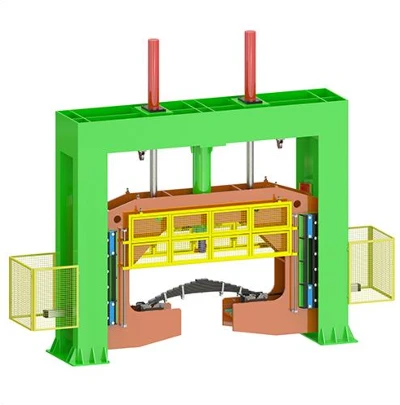
For leaf spring manufacturers, achieving the required spring curvature is an important part of producing suspension components that meet dimensional and performance requirements.
A leaf spring cambering machine is used to form or adjust the curvature of spring leaves. Depending on the manufacturing process, cambering equipment may operate as a standalone forming machine or as part of an integrated leaf spring heat treatment line.
However, selecting suitable equipment involves more than comparing hydraulic pressure or machine price. Spring dimensions, target camber, tooling design, production capacity, and integration requirements all influence the final machine configuration.
This guide explains the key factors manufacturers should consider before purchasing a leaf spring cambering machine.
1. Confirm the Leaf Spring Size Range
The first step in equipment selection is to identify the range of spring leaves that the machine must process.
Important product specifications include:
Minimum and maximum leaf spring length
Spring width and thickness
Steel grade
Workpiece weight
Single-leaf or multi-leaf spring applications
Required product varieties
Longer or thicker spring leaves may require different forming forces, support arrangements, and machine working dimensions.
For manufacturers producing multiple spring models, the equipment must accommodate the required product range without excessive adjustment.
Providing representative product drawings allows the supplier to evaluate the machine's working range and structural requirements.
2. Evaluate the Required Forming Force
Forming force is an important parameter when selecting a leaf spring cambering machine.
The required force depends on several factors, including material properties, spring thickness, forming temperature, target curvature, and tooling arrangement.
A machine with a higher rated hydraulic force is not necessarily the most suitable option.
The forming force should be calculated according to the actual products and process conditions.
Manufacturers should confirm:
Maximum required forming force
Machine rated capacity
Hydraulic system configuration
Forming stroke
Working speed
Structural rigidity
The equipment should provide sufficient forming capability while maintaining stable operation under the expected production load.
3. Understand Camber Height and Dimensional Accuracy
Camber height is one of the important dimensional requirements for a leaf spring.
Different spring designs may require different curvature profiles and camber tolerances.
Before purchasing equipment, manufacturers should define the target camber height and the acceptable dimensional deviation.
Other important considerations include:
Required curvature profile
Camber measurement method
Forming position accuracy
Repeatability between workpieces
Allowable product tolerances
The machine's positioning system, tooling geometry, and control method can all influence forming consistency.
However, the final spring curvature may also be affected by material properties and subsequent heat treatment conditions.
For this reason, machine accuracy and finished-product camber tolerance should be evaluated separately.
4. Review the Tooling and Support System
Tooling design directly affects the range of products that a cambering machine can process.
Different spring lengths, widths, and curvature requirements may require different forming dies, support positions, or adjustment methods.
When evaluating the tooling system, buyers should consider:
Compatibility with different spring dimensions
Forming die design
Support position adjustment
Tooling replacement procedures
Wear resistance
Maintenance accessibility
For factories manufacturing several leaf spring models, flexible tooling arrangements can reduce changeover time.
Buyers should ask the equipment supplier whether the required product specifications can be processed using adjustable tooling or whether dedicated dies are necessary.
5. Match the Machine With the Manufacturing Process
A leaf spring cambering machine must be selected according to its position in the manufacturing process.
Some applications require curvature forming before subsequent heat treatment operations. Other production arrangements may combine camber control with quenching-related equipment.
The appropriate configuration depends on the material condition, forming temperature, and selected production process.
Before purchasing, manufacturers should clarify:
Whether forming is performed hot or cold
Whether the machine operates before or after quenching
Required workpiece transfer time
Compatibility with existing heating equipment
Integration with quenching and handling systems
For a new leaf spring heat treatment line, the equipment supplier should evaluate the cambering machine together with the surrounding machines.
This helps avoid mismatched cycle times and unnecessary material handling.
6. Consider Production Capacity and Automation
Production capacity should be evaluated using the complete machine operating cycle.
The actual cycle may include loading, positioning, clamping, forming, unloading, and inspection.
For manufacturers producing different spring models, product changeover time should also be considered.
Depending on the project, equipment configurations may include:
Manual loading and unloading
Semi-automatic forming
Automatic positioning
PLC-controlled operation
Robotic material handling
Integration with other production equipment
The required automation level should match the factory's production volume, product variety, and labor arrangements.
A highly automated machine may be suitable for continuous high-volume production, while a simpler configuration may be appropriate for flexible manufacturing with frequent product changes.
7. Examine the Hydraulic and Control Systems
Hydraulic systems are widely used in industrial forming equipment because they can provide substantial forming force with controlled actuator movement.
When selecting a hydraulic leaf spring cambering machine, manufacturers should evaluate the hydraulic cylinders, pumps, valves, pressure control, and cooling requirements.
The control system should also support the required operating functions.
Depending on the equipment configuration, these may include:
Forming position settings
Hydraulic pressure monitoring
Operating sequence control
Fault alarms
Product parameter management
Safety interlocks
For international projects, buyers may also specify preferred PLC brands, electrical components, operating languages, and applicable safety requirements.
These details should be confirmed before finalizing the technical agreement.
8. Evaluate Maintenance and Long-Term Operating Costs
Equipment purchase price is only one part of the total investment.
Manufacturers should also consider maintenance requirements, spare parts, energy consumption, tooling replacement, and possible production downtime.
For hydraulic equipment, routine maintenance may involve checking oil condition, seals, hoses, filters, and hydraulic components.
Forming dies and support mechanisms should also be inspected for wear and alignment.
Before purchasing, buyers should ask about maintenance access, spare-part availability, technical documentation, and operator training.
A machine that is easy to maintain and adjust can help reduce interruptions during daily production.
What Information Is Needed for a Cambering Machine Quotation?
To receive a suitable equipment proposal, leaf spring manufacturers should prepare:
Leaf spring drawings and product dimensions.
Minimum and maximum spring thickness and width.
Steel grades and material specifications.
Required camber height and dimensional tolerances.
Hot or cold forming requirements.
Target production capacity.
Preferred automation level.
Existing equipment and factory layout information.
For projects involving multiple spring models, representative drawings covering the complete product range are particularly useful.
This information helps the equipment supplier evaluate forming force, tooling arrangements, machine dimensions, and automation requirements.
Choose a Cambering Machine Based on Your Production Needs
A suitable leaf spring cambering machine should provide the required forming capability, dimensional control, tooling flexibility, and production capacity.
Instead of selecting equipment based only on hydraulic force or purchase price, manufacturers should evaluate how the machine will perform with their actual spring products and manufacturing process.
JIMENG designs and manufactures customized leaf spring manufacturing equipment, including cambering and forming solutions for leaf spring heat treatment production lines.
Manufacturers planning a new production line or upgrading existing equipment can share their spring drawings, camber requirements, and target capacity for preliminary technical evaluation and equipment quotation.


